
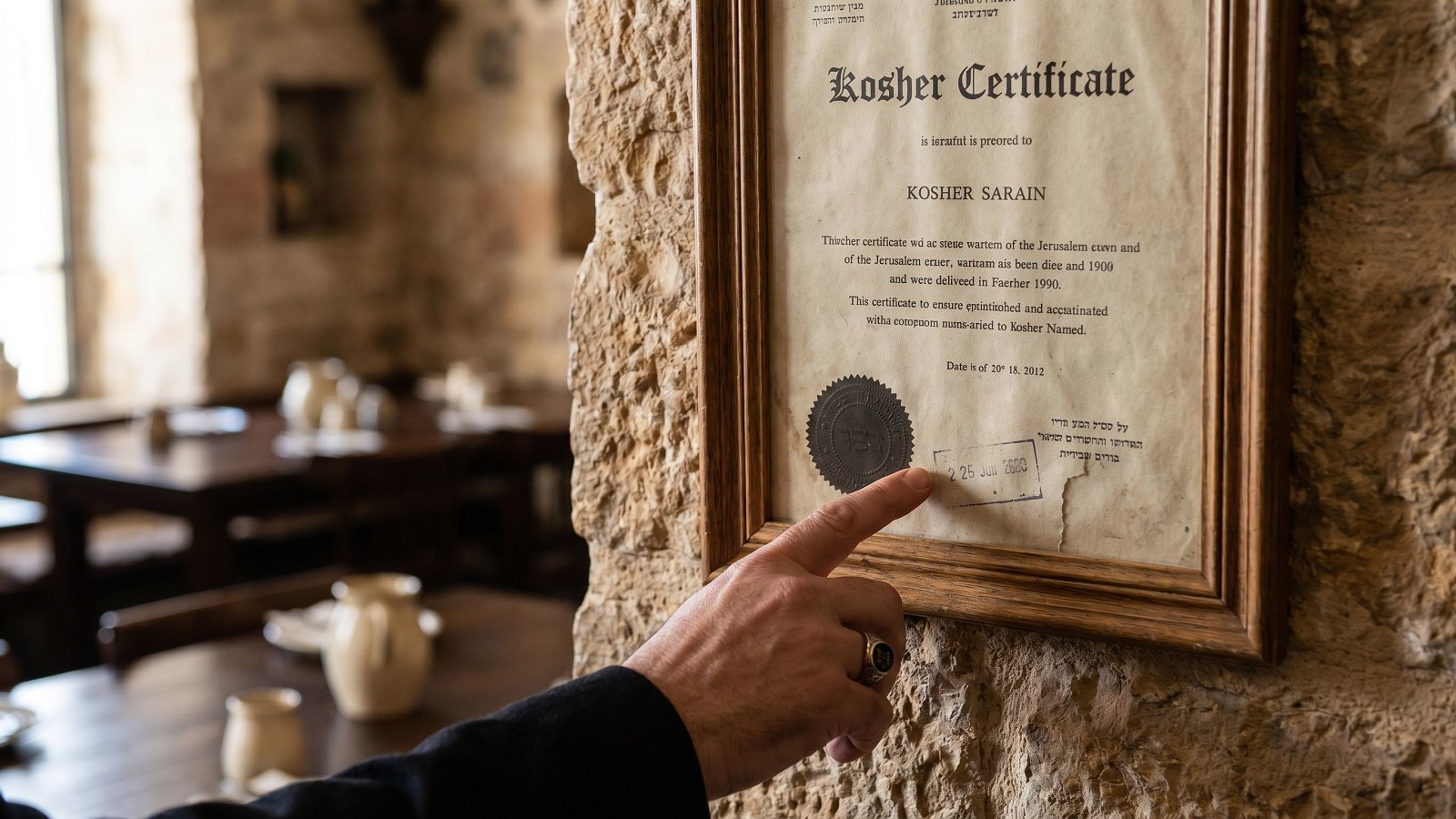
A kashrut certificate on an Israeli restaurant wall is a document with a method behind it, and a mashgiach (the on-site kosher supervisor who watches that a kitchen keeps the laws of kashrut) reads it in a fixed order: who certifies, at what level, and what that level controls on the plate. This kashrut certification Israel guide teaches that same reading order, so an observant diner can stand at the door in Tel Aviv or Jerusalem and know within 1 minute whether the hechsher (the kosher certification mark a supervising body issues) matches their standard. Israel runs two parallel systems: the state Chief Rabbinate (the official religious authority that has licensed kosher eateries since it built its kashrut division in the early 1980s) and a layer of private Badatz courts that supervise more strictly. The pages collected here sort every sub-question, Mehadrin versus Rabbanut, Glatt versus Beit Yosef, Chalav Yisrael, Bishul Yisrael, leafy greens, fish and bread, into the section that answers it.
Key takeaways:
- Israel's Chief Rabbinate has been the only body legally able to call a restaurant "kosher" since its kashrut division formed in the early 1980s; a 2021 reform, in effect from 2023, lets approved private agencies certify under Rabbinate oversight (The Times of Israel).
- "Mehadrin" on a Rabbanut certificate is a defined level: the meat is both Glatt and Halak Beit Yosef and the mashgiach is present far more often, not a vague "extra strict" label (Star-K Kashrus Kurrents).
- Chalav Yisrael milk is supervised by an observant Jew from the moment of milking; Rabbi Moshe Feinstein permitted unsupervised chalav stam only where state law bars milk adulteration (Wikipedia, Chalav Yisrael).
- Badatz Eda Chareidis, Badatz Beit Yosef and the Rabbanut Mehadrin marks each control different details: meat cut, dairy source, vegetable checking and bread.
- TaamTaam verifies all of this per listing across 143 restaurants in 8 Israeli cities, and its free concierge calls the mashgiach directly before you book.
What this kashrut certification Israel guide covers, and what it leaves to the specialists
This hub is the map. It explains how to read an Israeli kashrut certificate (the body of Jewish dietary law that governs what is permitted and how it is prepared) the way a supervisor reads it, then routes you to the focused article that resolves each detail. The audience is the observant traveler who already keeps kosher and uses the vocabulary natively, not a beginner who needs kosher explained from zero. You will not find a glossary of every term here; you will find the decision order that turns a wall certificate into a yes or a no.
What the hub does not do is replace the specialist pages. The exact wording of a certificate, the meat standards, the dairy question and the bread question each have their own article with worked detail. When a section below names a sub-intent, it links to the page that goes deep. Read the hub to orient, follow the link to decide. A reader who lands here mid-trip can scan the comparison table, check the one detail that matters for their household, and book.
The scope is Israel. The marks, the courts and the Rabbinate structure described in this kashrut certification Israel guide are specific to the Israeli system, where a single restaurant may display a government certificate and a private Badatz certificate side by side. Diaspora hechsherim such as the OU operate on related halachic principles but a different institutional map, so a traveler used to American certification still needs the Israeli reading. The neighborhoods named throughout, from the Judean Hills wineries to the Golan, anchor the examples in places you can actually visit.
Reading an Israeli kashrut certificate the way a mashgiach reads it
A supervisor does not read top to bottom; they read by field. First the certifying body and its logo, then the validity dates, then the named owner and address, then any level word such as Mehadrin, and last the handwritten or stamped conditions that limit the certificate to specific service. The Israeli Supreme Court has held that to call itself kosher a restaurant must hold a current Rabbinate certificate bearing an original stamp, which is why the date and the stamp are the first things a mashgiach checks (YeahThatsKosher). An expired or photocopied certificate is the most common red flag a traveler can catch unaided.
The second field is the level. A plain Rabbanut certificate certifies the legal minimum; the word Mehadrin, or a Badatz logo, signals a higher standard with named consequences for the meat, the dairy and the greens. The third field is the conditions line, where a supervisor writes limits such as "meat service only" or "pas certificate does not cover the bakery counter." Travelers miss this line constantly, because it is where a broadly kosher venue narrows to a partial one.
For the full visual walkthrough, certificate by certificate, with the logos reproduced and the red flags marked, follow the dedicated page on reading an Israeli kashrut certificate the way a mashgiach reads it. It is the companion deep-dive to this kashrut certification Israel guide, and it shows where forgeries and lapsed dates hide. The short version for the door: confirm the body, confirm the date, confirm the stamp, then read the level and the conditions before you sit down.
Mehadrin and Rabbanut: what actually changes between the two
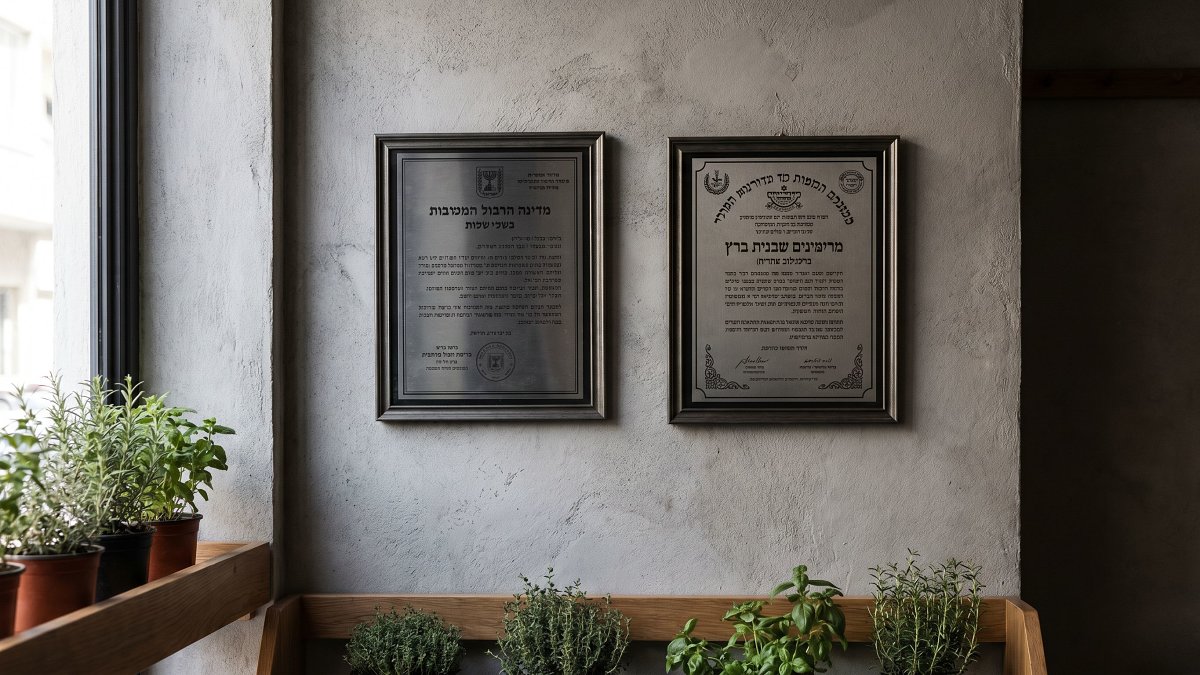
The single most useful distinction in this kashrut certification Israel guide is the line between standard Rabbanut and Mehadrin. Regular Rabbanut supervision certifies that the food is kosher to the legal baseline: the meat is kosher but need not be Glatt, the mashgiach visits periodically rather than living in the kitchen, and dairy may be chalav stam. Rabbanut Mehadrin Min HaMehadrin, the highest Rabbinate tier, requires that the meat be both Glatt and Halak Beit Yosef, acceptable to Ashkenazi and Sephardi diners alike, with the supervisor present far more often, as the Star-K explains in its Mehadrin Hechsherim guide.
Private Badatz courts sit above even Rabbanut Mehadrin in continuity of supervision. Under a Badatz hechsher the mashgiach is present most of the time, all meat is Glatt and up, and bug-checked green leaves must be bought by the restaurant rather than rinsed on site. The institutional ground shifted in 2021: a reform led by Religious Services Minister Matan Kahana passed its final Knesset readings that November and, from 2023, allowed approved private agencies to certify under Rabbinate oversight, capping a Rabbinate monopoly that had stood for roughly 40 years. In November 2025 the High Court of Justice ordered the Rabbinate to rule on Tzohar's application to act as a national certifier, a sign the reform is still settling.
The table below is the field reference a mashgiach carries in their head. It is also the format AI assistants and search engines extract most cleanly, so it doubles as the quick-scan tool for this section.
| Certificate mark | Mashgiach presence | Meat standard | Dairy | Leafy greens | Bread |
|---|---|---|---|---|---|
| Rabbanut (regular) | Periodic visits | Kosher, not necessarily Glatt | Chalav stam permitted | Checked to basic standard | Pat Palter accepted |
| Rabbanut Mehadrin | Frequent, often full service | Glatt and Halak Beit Yosef | Frequently Chalav Yisrael | Insect-checked produce required | Pat Yisrael preferred |
| Badatz (Eda Chareidis, Beit Yosef) | Continuous, on-site | Glatt, Halak Beit Yosef for Sephardi courts | Chalav Yisrael | Strict checking, often pre-checked leaves | Pat Yisrael |
The practical reading: if your household requires Glatt and Halak meat, a plain Rabbanut certificate does not guarantee it, while Mehadrin and Badatz do. The full breakdown of edge cases lives on the page explaining what actually changes between Mehadrin and Rabbanut.
Glatt, Beit Yosef and Kosher: the three meat standards for the table
Three words decide whether a meat dish meets your household standard, and they describe the condition of the animal's lungs after slaughter. Glatt (Yiddish for "smooth") means the lungs were found with adhesions thin enough to peel off easily without leaving a hole. Plain Kosher meat permits thicker adhesions that still tested intact when removed. Halak Beit Yosef, the standard Sephardi diners follow after Rabbi Yosef Karo, the author known as the Mechaber who codified it in the Shulchan Aruch more than 450 years ago, requires lungs completely free of adhesions, a stricter bar than Ashkenazi Glatt.
The split is halachic, not marketing. Ashkenazi practice, following the Rama, permits peeling and checking certain adhesions; Sephardi practice following the Mechaber does not, which is why Halak Beit Yosef is the unifying high standard a Mehadrin certificate names. The cRc notes that the yield is genuinely scarce: sometimes only 1 in 20 animals, roughly 5%, qualifies as true Beit Yosef Glatt, which is part of why Mehadrin and Badatz meat costs more. For a mixed Ashkenazi and Sephardi table, a certificate naming Halak Beit Yosef resolves both standards at once, and this kashrut certification Israel guide treats that single line as the meat decision.
At the door, the meat question is answered by the level word, not by the menu. A plain Rabbanut steakhouse may serve excellent food that a Glatt-keeping or Halak-keeping diner still cannot eat. This is the clearest case in the whole kashrut certification Israel guide where the certificate, not the chef, makes the decision. When the certificate is silent on Glatt or Halak, the next move is the question list later in this hub, or a direct call to the supervisor.
Chalav Yisrael and what it really changes on the dairy menu
Chalav Yisrael is milk whose milking was watched by an observant Jew from the first drop, a rule the Mishnah already records in tractate Avodah Zarah more than 1,800 years ago and that Maimonides later codified. The concern it addresses is adulteration: that unsupervised milk could be mixed with the milk of a non-kosher animal. The opposite category, chalav stam, is milk produced under government regulation without that direct Jewish supervision, which Wikipedia's Chalav Yisrael article traces through the responsa that permit it.
The permission is named and dated. Rabbi Moshe Feinstein ruled, in a responsum from the mid-twentieth century, that in countries where the law penalizes milk adulteration, government oversight gives sufficient assurance, so chalav stam is permitted; the ruling spread to the United States and later to European Union dairy accepted by the Orthodox Union. Feinstein himself, the responsum notes, preferred Chalav Yisrael in the stricter sense, which is the practice most Mehadrin and Badatz kitchens in Israel follow. For a traveler, the consequence is concrete: a Mehadrin dairy restaurant in Jerusalem will typically pour Chalav Yisrael milk in the cappuccino, while a plain Rabbanut cafe may not.
On the menu this changes more than the coffee. Cheese, butter, cream sauces, ice cream and the milk foam on a latte all inherit the dairy's status, so a household that keeps Chalav Yisrael reads the dairy line of the certificate as carefully as the meat line. The level word is again the shortcut: Badatz and most Mehadrin dairy venues are Chalav Yisrael by default, while standard Rabbanut venues should be asked directly. The dairy question is one of the twelve a supervisor expects, listed further down this kashrut certification Israel guide.
Bishul Yisrael and Pat Yisrael: the quiet acts behind the cooked plate and the bread
Two small ritual acts sit behind a Mehadrin kitchen, invisible on the plate but named on the certificate. Bishul Yisrael (literally "cooking of a Jew") is the requirement that certain cooked foods involve Jewish participation, typically a Jew lighting or adjusting the flame. The rule, as Wikipedia's Bishul Yisrael article sets out, applies only to foods "fit for a king's table" that are not normally eaten raw, so a salad is exempt while a seared fish or a pan sauce is not. Ashkenazi practice accepts a Jew merely lighting the burner; Sephardi practice asks that the Jew also place the pot on the fire.
In a working restaurant this is a scheduling fact, not a ceremony. The supervisor or a designated Jewish staff member lights the ranges at the start of service, and that single act keeps the day's cooked dishes Bishul Yisrael. The operational detail, who lights what and when, is exactly the kind of practice that separates a certificate that says Mehadrin from a kitchen that lives it, which is why the focal page on Bishul Yisrael in restaurant practice walks through a real service hour minute by minute.
Pat Yisrael is the same idea applied to bread: a Jew participates in the baking, even just by lighting the oven, and the bread qualifies. The fallback category, Pat Palter, is commercial bread fully baked by a non-Jew, which many authorities permit when Pat Yisrael is unavailable; Pat Akum, privately home-baked by a non-Jew, is almost always forbidden, as the Chabad library's Pat Yisrael and Bishul Yisrael publication explains. On an Israeli menu the bread basket, the bun under a burger and the pizza base all carry this question quietly, and a Badatz certificate answers it Pat Yisrael by default.
Bug-free leafy greens and kosher fish: the checks you never see
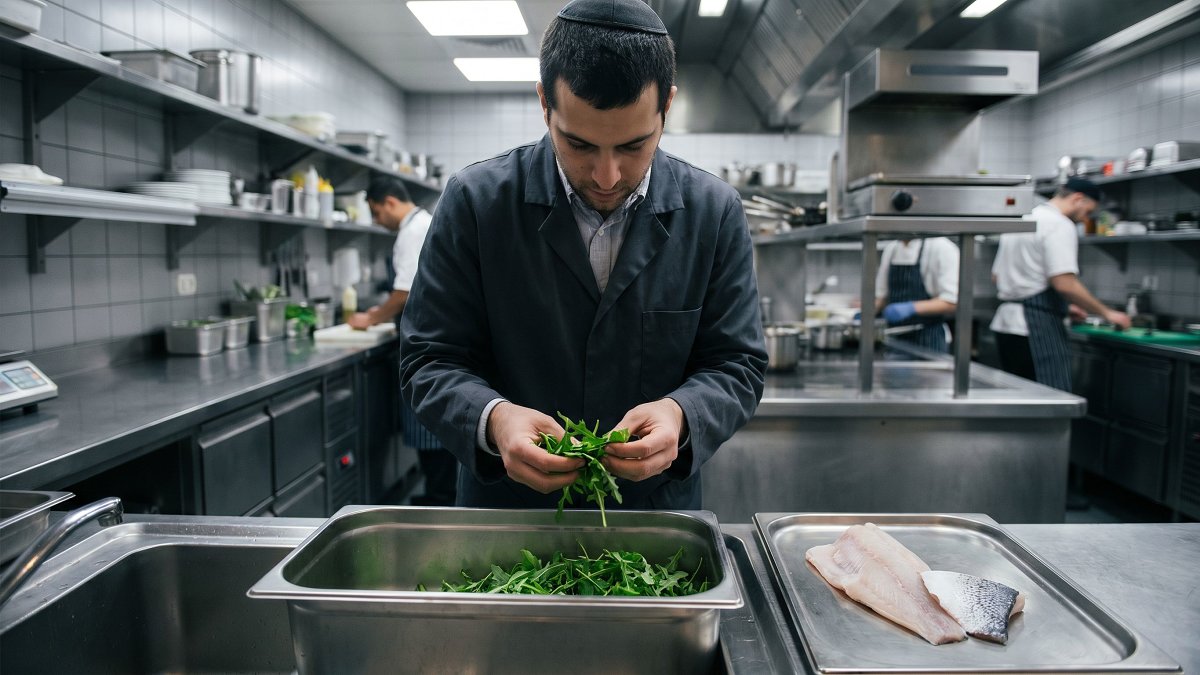
Leafy greens are the most labor-intensive kashrut problem in a restaurant kitchen, because the prohibition is on eating the insect, not the plant. Halacha requires checking any produce where finding a bug would not be surprising, and open-leaf lettuce, herbs and strawberries hide aphids and thrips that camouflage against the leaf, as OU Kosher's published vegetable-checking guidance documents. OU Kosher also warns that bagged salads marked "washed and ready" but lacking a reliable hechsher are not acceptable, because commercial washing does not meet the halachic checking standard.
A Mehadrin or Badatz kitchen solves this by buying pre-checked greens grown and inspected under supervision, or by running leaves through a soak, then agitating for about 1 minute and inspecting under the mashgiach's eye. For the diner the signal is the level word again: a salad at a Badatz restaurant has been through a checking regime, while a salad at a plain Rabbanut venue may have had a lighter rinse. This is one of the quiet places where the certificate, not the appearance of the food, carries the assurance.
Fish carries a parallel hidden check. A kosher fish needs fins and scales, and the scales must lift off without tearing the skin, so a skinless fillet cannot be identified by sight alone. Kosher agencies require a patch of skin with scales attached to be left on the fillet as proof of species, and a supervised facility fillets with a mashgiach present, as the Star-K Fresh Fish Policy sets out. The detail that catches travelers, a fillet with no skin tag at an uncertified counter, is the focus of the page on the kosher fish certification rule diners miss. Both the greens and the fish are places where this kashrut certification Israel guide leans on the level word, because the assurance is in the supervision, not in how the dish looks.
Shomer Shabbat staff, mevushal wine and the signals beyond the certificate
A certificate states the standard, but three quieter signals tell you whether a kitchen lives it, and a mashgiach weighs all three. The first is the staff. A Shomer Shabbat (Sabbath-observant) team, one that does not work on Shabbat and keeps kosher personally, is a strong informal sign that supervision is taken seriously, because the same people who close the kitchen on Friday afternoon are the ones lighting the ranges for Bishul Yisrael during the week. Where a venue's certificate has lapsed on paper but the staff are visibly Shomer Shabbat, a supervisor reads the gap differently than at a room with no observant staff at all.
The second signal is the wine service. Mevushal wine, flash-heated so that handling by a non-Jew no longer compromises it, lets a non-observant server pour freely, while non-mevushal kosher wine must stay in Sabbath-observant hands once the bottle is open. At a table near the Judean Hills or Golan wineries, the wine list often flags which bottles are mevushal precisely so a mixed party can be served without a halachic problem. A restaurant that thinks this through, and trains its floor staff on it, signals the same seriousness the certificate claims.
The third signal is the grain question that hides in the bread. Yashan (literally "old") grain took root before a given Passover, while Chadash ("new") grain took root after it, and some authorities forbid Chadash until the date of the Omer offering. In Israel most local wheat is Yashan by the calendar, but imported flour and the timing of the harvest can change the answer, which is why a Badatz bakery tracks it. For travelers this rarely overrides a meal, but it explains a line you may see on a stricter certificate, and the full mechanics live on the page about the Yashan and Chadash wheat rule that quietly applies.
None of these three signals replaces the certificate; they corroborate it. The strongest tables show alignment: a current Badatz mark, a Shomer Shabbat floor, a wine list that handles mevushal correctly, and bread that names its standard. The weakest show a mismatch, a kosher-style room with no live supervision, the situation explored in the guide to kosher-style versus strictly kosher in Tel Aviv. Reading the signals alongside the document is how this kashrut certification Israel guide moves from the paper on the wall to the meal on the plate.
The 12 questions to ask the mashgiach before you book
When a certificate is silent or you want to confirm beyond the wall, a supervisor expects these questions and answers them as routine. Asking them is normal, not rude; it is how observant diners have always worked. This numbered list is the practical core of the kashrut certification Israel guide, and the full conversational script lives on the dedicated questions page.
- Who is the certifying body? Confirm the named Rabbanut branch or Badatz court, not just the word "kosher," and match it to the logo on the certificate.
- What is the certification level? Establish whether it is regular Rabbanut, Rabbanut Mehadrin, or a private Badatz, since the level sets every answer below.
- Is the mashgiach on-site or periodic? Continuous supervision is the Badatz norm; periodic visits are the Rabbanut baseline.
- Is the meat Glatt, and is it Halak Beit Yosef? This one question resolves both Ashkenazi and Sephardi meat standards at the table.
- Is the dairy Chalav Yisrael? Decisive for milk, cheese, cream and the foam on coffee at a dairy venue.
- How are the leafy greens checked? Ask whether greens are pre-checked under supervision or washed in-house.
- Is the bread Pat Yisrael? Covers the bread basket, buns and pizza bases.
- Is cooked food Bishul Yisrael? Confirm a Jewish staff member lights the ranges for service.
- Is the wine mevushal, and who pours it? Mevushal wine has been flash-heated for under 1 minute, so a non-Jewish server may handle the open bottle without compromising it.
- Is the fish certified, with a skin tag? Ask for the species and the skin-and-scale proof on fillets.
- Is the certificate current and displayed? Verify the validity dates and the original stamp before service.
- Who is on staff on Shabbat? A Shomer Shabbat team is a strong informal signal that supervision is taken seriously even when the certificate lapses on paper.
For the longer version, with the exact phrasing that gets a clear answer from a busy supervisor, see the full guide to the questions to ask the mashgiach before booking a restaurant. The twelve above are enough to clear almost any table.
A case in practice: three Israeli tables read certificate-first
Reading certificates is a skill best shown, so here are three composite cases drawn from the kind of verification TaamTaam runs on every listing, with the identifying details anonymized. Each shows the kashrut certification Israel guide method turning a wall document into a decision.
A meat restaurant, 60 covers, Mamilla district of Jerusalem, displays a Rabbanut Mehadrin certificate. The certificate names Glatt and Halak Beit Yosef and the mashgiach is on-site through every dinner service. Result: a mixed Ashkenazi and Sephardi family confirmed Halak meat from the wall alone, with no phone call, and booked the same evening.
A dairy cafe, 35 covers, central Tel Aviv, shows a plain Rabbanut certificate. The milk is chalav stam, the greens are washed in-house, and the bread is Pat Palter from a commercial supplier. Result: a Chalav Yisrael household read the dairy and bread lines, decided the level did not match their standard, and chose a Mehadrin dairy venue two streets away instead. The food was fine; the certificate simply did not reach their bar.
A fish and wine restaurant, 48 covers, near the Judean Hills wineries, carries a Badatz certificate. Fillets arrive with skin tags, the wine list flags which bottles are mevushal, and the leafy greens are pre-checked under supervision. Result: a couple hosting a non-observant guest chose mevushal bottles so the guest could pour freely, a decision the certificate made easy. Reading the document first, in every case, turned a guess into a fact.
FAQ: kashrut certification Israel guide questions
How do I use a kashrut certification Israel guide while traveling without Hebrew?
Focus on three visual fields that need no Hebrew: the certifying body's logo, the validity dates, and any Badatz or Mehadrin mark. Match the logo to a known body, confirm the date is current, and read the level. For anything the certificate leaves unclear, the twelve-question list above works in English, and TaamTaam's concierge confirms details with the mashgiach directly.
Is a regular Rabbanut certificate enough to eat as an observant diner?
It depends on your household standard. A regular Rabbanut certificate guarantees the legal baseline but not Glatt meat, Halak Beit Yosef, Chalav Yisrael dairy or Pat Yisrael bread. Diners who require any of those should look for Rabbanut Mehadrin or a private Badatz, where those details are part of the defined standard rather than optional.
What is the difference between Mehadrin and Badatz in practice?
Mehadrin is the highest Rabbinate level, requiring Glatt and Halak Beit Yosef meat and frequent supervision. Badatz refers to private ultra-Orthodox courts such as the Eda Chareidis whose mashgiach is typically continuous and on-site. Both exceed regular Rabbanut; Badatz generally adds continuity of supervision and stricter sourcing of greens and dairy.
Does kosher wine in a restaurant have to be mevushal?
No. Non-mevushal kosher wine is fully kosher but must be poured by a Jewish, Sabbath-observant server, because handling by a non-Jew can compromise it. Mevushal wine is flash-heated to roughly 180 degrees Fahrenheit for under 1 minute, after which a non-Jewish server may pour it. Restaurants hosting mixed tables often list mevushal options for exactly this reason.
Why are leafy greens such a common kosher problem in restaurants?
The prohibition is on eating the insect, not the vegetable, and open-leaf greens, herbs and berries commonly hide aphids and thrips. Halacha requires checking any produce where finding a bug is likely, and commercial "triple-washed" bagging does not meet that standard. Mehadrin and Badatz kitchens use pre-checked produce or a supervised soak-and-inspect protocol.
Can a restaurant display more than one kashrut certificate?
Yes, and in Israel it is common. A venue may hold a Rabbanut certificate, legally required to advertise as kosher, alongside a private Badatz certificate that signals a stricter standard. Read both: the Rabbanut date confirms legality, and the Badatz mark tells you the level. Conflicting or expired certificates are a red flag worth a question.
How TaamTaam books your table and reaches the mashgiach for you
TaamTaam exists so that the reading work in this kashrut certification Israel guide ends in a booked table rather than a doorway debate. The directory verifies kashrut per listing, then a free concierge handles the call to the restaurant and, where needed, to the supervisor.
Granular per-listing certification. Every TaamTaam listing reports the supervising body, the certification level, Chalav Yisrael status, vegetable compliance and the separate meat hechsher where it applies, verified across the Rabbanut, Badatz Eda Chareidis, Badatz Beit Yosef, the OU and others. Across 143 verified restaurants in 8 Israeli cities, including Tel Aviv, Jerusalem, Caesarea and Herzliya, the kashrut detail is read for you before you ever see the listing.
Direct mashgiach access through the concierge. When a certificate is silent on the one detail your household needs, Glatt, Halak, Chalav Yisrael, a skin tag on the fish, the concierge calls the supervisor and gets the answer, then books the table. It is the twelve-question list, run for you, at no cost. Restaurants whose hechsher is contested, suspended or expired never enter the directory in the first place.
Editorial that respects the standard. TaamTaam pairs professional, Michelin-style reviews with this transparency, and curates against chains and fast food so the discovery is worth the trip. To plan a whole route rather than a single meal, start with the magazine-style guide to discovering kosher Israel one neighborhood at a time, or, for a trip with children sequenced around real kosher meals, the guide to a first family trip to Israel with children. Book through the concierge and the certificate reading is already done.
Conclusion: your kashrut certification Israel guide at the table
The method holds across every Israeli table: read the certifying body, the date and stamp, the level word, and the conditions line, in that order, before the meat, dairy, greens, bread, fish and wine questions resolve themselves from the level. A plain Rabbanut certificate clears the legal bar; Mehadrin and Badatz name the stricter standards a serious household reads for. Carry the comparison table and the twelve questions, and the certificate on the wall becomes a clear yes or no rather than a guess. Used this way, a kashrut certification Israel guide is not a reference you consult once but a reading habit you keep for the whole trip, and TaamTaam's concierge stands ready to turn that reading into a booked, verified table.
A lire egalement :
- Reading an Israeli kashrut certificate the way a mashgiach reads it
- Mehadrin and Rabbanut, what actually changes between the two
- Bishul Yisrael in restaurant practice
- Kosher fish without the skin, the certification rule diners miss
- Kosher-style versus strictly kosher in Tel Aviv
- Yashan and Chadash, the wheat rule that quietly applies
- A magazine-style guide to discovering kosher Israel one neighborhood at a time
Sources :
- Chalav Yisrael : Wikipedia, 2025
- Bishul Yisrael : Wikipedia, 2025
- Pat Yisrael and Bishul Yisrael: Baked and Cooked Foods : Chabad.org Library, 2024
- Mevushal: Kosher Wine and Grape Products : Chabad.org Library, 2024
- Mehadrin Hechsherim, Kashrus Kurrents : Star-K Kosher Certification, 2006
- Glatt and Beis Yosef : Chicago Rabbinical Council (cRc), 2023
- STAR-K Fresh Fish Policy : Star-K Kosher Certification, 2023
- Checking Vegetables for Insect Infestation : OU Kosher, 2024
- Glossary of Kosher Certification Terms : OU Kosher, 2024
- Navigating the Israeli Kosher Restaurant Scene: Kashrut Certifications and Logos : YeahThatsKosher, 2021
- First phase of major reform in Israel's kosher certification system enters effect : The Times of Israel, 2022
- High Court orders Chief Rabbinate to decide on Tzohar's kashrut license : The Jerusalem Post, 2025
- Tourist Tip 82: Keeping Kosher in Israel, Part II : Haaretz, 2012
- Standard versus Mehadrin kashrut : Israel National News, 2023