
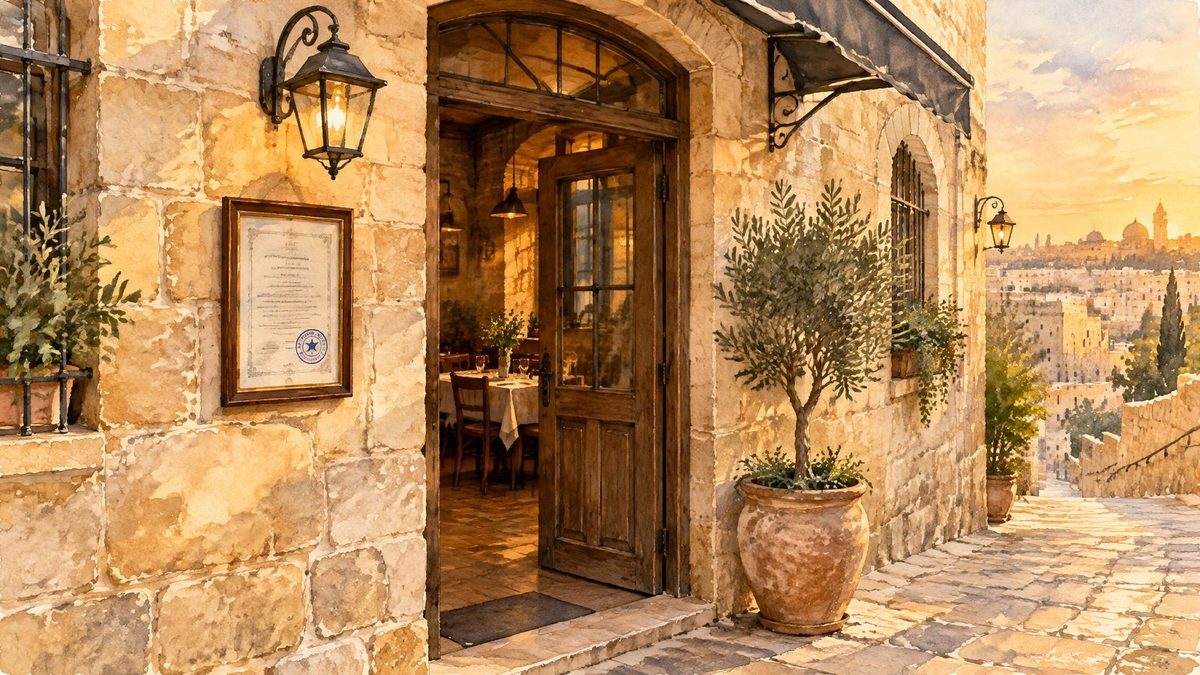
An Israeli kashrut certificate, the teudat kashrut framed near the door or the register, tells you which body supervises a kitchen, at what level, for meat or dairy, and until which date. Most diners glance at it and sit down. A mashgiach, the kashrut supervisor who checks the kitchen, reads it in a fixed order: issuing authority, kashrut level, meat or dairy status, validity dates, original stamp, supervisor name. This guide follows that order across the five documents an observant visitor meets most in Israel: standard Rabbanut, Mehadrin Rabbanut, Badatz Eda Chareidis, Badatz Beit Yosef and OU. The Israel Democracy Institute counted 14,700 Israeli businesses holding a kashrut certificate in 2019, so the skill pays off at almost every meal.
Key takeaways:
- The 1983 Law against Kashrut Fraud lets a food business present itself as kosher only with a certificate from the body the law authorizes, as The Times of Israel reported on the June 2016 High Court ruling.
- In 2019, 79% of all kashrut certificates in Israel were mehadrin, according to the Israel Democracy Institute study published on September 30, 2021.
- In late 2020, then Chief Rabbi Yitzchak Yosef instructed the Rabbanut to print the meat standard and the bishul Yisrael status on its certificates, as Life in Israel reported on December 7, 2020.
- YeahThatsKosher's May 2021 guide warns that some restaurants display scanned or photoshopped certificates; a valid one carries an original Rabbanut stamp and current dates.
Who may issue an Israeli kashrut certificate?
Only a state rabbinic body may issue an Israeli kashrut certificate that carries the word kosher. The Law against Kashrut Fraud (1983), the statute governing how food businesses present their kashrut, bars an establishment from calling itself kosher without a certificate from an authorized body. In June 2016, The Times of Israel reported that the High Court of Justice read the law to mean that a business is prohibited from presenting its kashrut status in writing, whether by using the word kosher or not, without that certificate. Rabbi Dovid Stein, Star-K's Israel representative, wrote in Star-K's Kashrus Kurrents that the only body permitted to write the word kosher on a product or eating establishment is the Rabbanut or an organization the Rabbanut sanctions.
The Rabbanut (the Chief Rabbinate of Israel and its network of local religious councils) therefore sits under every certified kitchen. YeahThatsKosher's guide, compiled by chef Yehudah Jacobs, states that every kosher establishment must hold a basic Rabbanut certificate before any private hechsher (a kashrut endorsement from a named supervising body) is added. Private Badatz certifications, from beit din tzedek, a rabbinical court, then layer stricter standards on top of that base. Our kashrut literacy and mashgiach access hub maps the full landscape.
The density of certificates depends on the city. Israel Hayom, reporting the Israel Democracy Institute data in October 2021, found kashrut certification at 90% of food businesses in the Jerusalem District and Judea and Samaria, 81% in the Central District and 49% in the Tel Aviv District. The Times of Israel put the scale of the state system at 6.4 million supervision hours a year and an estimated direct cost of NIS 318 million in its October 2021 report on the same study.
The Rabbanut certificate, field by field
The standard Israeli kashrut certificate is a printed Rabbanut form issued by the religious council of the city where the restaurant operates, and each field answers one question a mashgiach asks. According to YeahThatsKosher's guide to Israeli kashrut logos, a restaurant declaring itself kosher must be under local Rabbanut supervision and display an up-to-date certificate with an original Rabbanut stamp. Seven fields deserve a look, in this order:
- Issuing council. The header names the local religious council, for example the Jerusalem Religious Council; its city should match the address on the door.
- Business name and address. The certificate covers the named business at the named address, so a branch across town needs its own document.
- Kashrut level. Kasher (standard), Mehadrin, or in Jerusalem the intermediate Mehuderet level, which Jerusalem Local dates to 2013.
- Meat, dairy or parve. The form states basari (meat), chalavi (dairy) or parve (neither meat nor dairy).
- Validity dates. Jerusalem Local notes that the validity period appears in both Hebrew and Gregorian dates.
- Original stamp. An inked Rabbanut stamp on the paper itself; a printed copy of a stamp fails this test.
- Supervisor name and phone. The assigned mashgiach, with a number a diner can call.
The 2020 update added detail to the level field. Life in Israel reported in December 2020 that Chief Rabbi Yitzchak Yosef instructed the Rabbanut to state the level of kashrut and the chalak status of the meat (Hebrew for smooth, a lung-inspection standard close to what Ashkenazim call Glatt), plus whether the food is bishul Yisrael (cooked with the participation of an observant Jew). An Israeli kashrut certificate issued after that change gives a Glatt-keeping diner more to read than the older one-word forms.
Standard supervision runs on short visits. In a sample of 345 pizzerias cited by The Times of Israel in October 2021, 14% required daily supervision of up to 30 minutes and 34% exactly half an hour. YeahThatsKosher adds that every Rabbanut mashgiach passes a test set by the Rabbanut and works within the jurisdiction of the local office that sends him.
Mehadrin Rabbanut versus standard Rabbanut on the same wall
Mehadrin Rabbanut and standard Rabbanut come from the same religious council, carry the same layout and differ by one printed word and a different supervision regime. Rabbi Eliezer Melamed set out the distinction in a November 2019 column for Israel National News: standard kashrut “goes according to the rules of halakha,” while mehadrin kashrut “takes into consideration the strict opinions, beyond what is required by halakha.” He added that standard kashrut suffices with occasional supervision, whereas under mehadrin “supervision is closer and stricter.” Mehadrin literally means beautified, from the Talmudic idea of enhancing a mitzvah.
The practical gap behind each Israeli kashrut certificate shows in the kitchen. Debra Kamin wrote in Haaretz's November 2012 travel column that a Mehadrin restaurant has a full-time inspector on staff and serves only glatt-certified meat. Star-K's Rabbi Dovid Stein described Mehadrin poultry lines slaughtering twelve birds a minute or less, against roughly 100 birds a minute on a non-Mehadrin line. YeahThatsKosher lists the Rabbanut Mehadrin conditions as glatt meat, bishul Yisrael, greens purchased bug free and Mehadrin products throughout, with Mehadrin min HaMehadrin as the highest Rabbanut level.
| Field | Standard Rabbanut (Kasher) | Rabbanut Mehuderet (Jerusalem) | Rabbanut Mehadrin |
|---|---|---|---|
| Meat | Kosher under halakha | Glatt, not Mehadrin | Glatt, Mehadrin products |
| Leafy greens | Council standard | Purchased bug free | Purchased bug free |
| Bishul Yisrael | Not stated | Not stated | Required |
| Supervision | Occasional visits | Council schedule | Close, on-site supervisor |
Spotting the level on an Israeli kashrut certificate
The level appears as a printed word, so read it in Hebrew: מהדרין for Mehadrin, מהודרת for Mehuderet, and כשר alone for the standard level. Haaretz's Debra Kamin observed that Mehadrin restaurants almost always splash their certification across awnings or windows, which makes the awning a first clue and the certificate the confirmation. In a hotel or a mall food hall, two outlets under one roof can hang certificates of two different levels within a few meters of each other; the business name line tells you which kitchen each document covers. The Israel Democracy Institute figure of 79% mehadrin among all certificates in 2019 means the stricter form is the one a visitor sees most.

Badatz Eda Chareidis and Badatz Beit Yosef: what changes on the certificate
A Badatz document looks different from the Israeli kashrut certificate issued by the Rabbanut because the law reserves the word kosher for the state. YeahThatsKosher notes that a Badatz certificate does not say kosher; it reads “under supervision” (בהשגחת). Since every kosher establishment holds the basic Rabbanut certificate, a Badatz restaurant displays two documents, and both deserve a reading.
Badatz Eda Chareidis (בד״ץ העדה החרדית) is the hechsher of the Edah HaChareidis rabbinical court in Jerusalem. YeahThatsKosher calls it the largest and oldest Badatz in Israel, relied on mainly by the ultra-Orthodox community. Badatz Beit Yosef (בד״ץ בית יוסף) follows the rulings of Rabbi Yosef Caro, author of the Shulchan Aruch. Rabbi Ovadia Yosef ran it until his death in 2013, and his son Rabbi Moshe Yosef runs it today; Wikipedia's entry estimates that 70% of Israeli restaurants use the Beit Yosef standard. The visual difference is the court name in the header and the signatures beneath it: Jerusalem's Edah HaChareidis on one, the Yosef family's Beit Yosef court on the other.
Other private names recur on Israeli walls. YeahThatsKosher lists Badatz Mehadrin (Rav Avraham Rubin, Rehovot), Badatz Yoreh Deah (Rav Shlomo Machpud) and Badatz Kehilos among the most common. Which Badatz you rely on is a question for your own rabbi; TaamTaam reports the supervising body on each listing without ranking one authority above another.
Where OU certification fits inside Israel
The OU (Orthodox Union, the New York-based kashrut agency) runs a local arm, OU Israel, and Jerusalem Local reported in September 2026 that OU Israel certifies a small number of restaurants and hotels itself. For a North American visitor, that is the one Israeli kashrut certificate whose standard matches the symbol on the packages at home. An OU-certified restaurant in Israel still sits inside the state system: the Rabbanut base certificate applies to it as to every kosher establishment, according to YeahThatsKosher. Read the OU certificate like a Badatz document, checking the business name, the meat or dairy status and the dates, then look for the Rabbanut form beside it. The OU symbol on a packaged product in a supermarket aisle certifies that product only.
How to verify the supervisor name with one phone call
The supervisor line is the most useful field on any Israeli kashrut certificate because it gives you a named person and a phone number. YeahThatsKosher states that a legitimate kosher business will not hide its certificate and will not object if you call the mashgiach to confirm it. Note the name and number, call before you order, and ask four questions: is the certificate current, which level does it cover, does it cover this outlet or the whole building, and is a supervisor on site today. The last question matters most at a Mehadrin kitchen, where Rabbi Eliezer Melamed describes supervision as on hand rather than occasional, and in the days before a chag (a Jewish festival). In Jerusalem, Jerusalem Local points to the Religious Council's online search at rabanut.org.il, which confirms a business's certificate and level. Outside Jerusalem, the phone call remains the fastest check. Planning a Shabbat in Jerusalem from Friday afternoon to Saturday night leaves no room for a surprise at the door, so make the call on Thursday.
Red flags on an Israeli kashrut certificate
An Israeli kashrut certificate that fails one of the checks below should send you to the phone or to another restaurant. TaamTaam's own rule is strict: we never recommend a restaurant whose hechsher is contested, suspended or expired.
- Expired dates. Jerusalem Local puts it plainly: an expired certificate means what it says.
- No original stamp. YeahThatsKosher warns that some restaurants scan and photoshop a certificate, create one, or explain why theirs is missing.
- Name or address mismatch. A certificate issued to another branch or another business covers that business only.
- The word kosher on an alternative certificate. YeahThatsKosher reports that supervision bodies outside the Rabbanut may not print kosher or kosher certificate; a non-Rabbanut document using those words is most likely fake.
- Status mismatch with the menu. A basari certificate next to a cheese plate is a question for the manager.
- A hidden certificate. Staff who will not show the document fail the first test YeahThatsKosher sets.
Cities with added Rabbanut levels deserve extra attention. YeahThatsKosher lists Jerusalem, Tiberias, Safed, Kiryat Gat and Rehovot as councils that issue extra levels under government supervision, so a diner in Tiberias or Safed in the Galilee can meet a council level that a diner in Herzliya will not. Plan the route with our magazine guide to discovering kosher Israel one neighborhood at a time, then read each certificate on arrival.
FAQ: Israeli kashrut certificate questions
Is a Badatz certificate enough without a Rabbanut certificate?
No. YeahThatsKosher's 2021 guide states that every kosher establishment in Israel must hold a basic Rabbanut certificate, and a Badatz hechsher is added on top of it. The Badatz document reads “under supervision” because the 1983 Law against Kashrut Fraud reserves the word kosher for the state system. Expect to see two documents at a Badatz restaurant and read both, starting with the dates.
How long is an Israeli kashrut certificate valid?
Each certificate is valid for a set period printed on its face, in both Hebrew and Gregorian dates, according to Jerusalem Local's September 2026 explainer. There is no single term to memorize, so read the end date on the paper you are looking at. If the end date has passed, treat the restaurant as uncertified until the mashgiach named on the certificate confirms a renewal by phone.
Does Mehadrin Rabbanut mean the same as Badatz?
No. Mehadrin Rabbanut is a stricter level issued by the same state religious council that issues the standard certificate, with glatt meat, bishul Yisrael and bug-free greens according to YeahThatsKosher. A Badatz is a private rabbinical court supervising on top of the Rabbanut base, and each Badatz applies the rulings of its own community. Ask your own rabbi which of the two you rely on.
Can I trust an OU symbol at a restaurant in Israel?
An OU certificate on a restaurant wall means OU Israel supervises that kitchen; Jerusalem Local reported in September 2026 that OU Israel certifies a small number of restaurants and hotels itself. An OU symbol on a packaged product inside the restaurant covers that product only. Confirm the OU certificate names the business and is current, and look for the Rabbanut base certificate beside it.
How TaamTaam reads the certificate for you
TaamTaam checks the Israeli kashrut certificate before you reach the door. Our free concierge books the table and calls the mashgiach for you, so you arrive knowing the level, the dates and the supervisor on duty.
Verified listings. TaamTaam launched with 143 verified kosher restaurants across 8 Israeli cities, with active coverage in Tel Aviv, Jerusalem, Caesarea and Herzliya.
Granular kashrut data. Each listing reports the supervising body, the certification level, Halav Israel status, vegetable compliance and a separate meat hechsher where one applies, verified across the Rabbanut, Badatz Eda Chareidis, Badatz Beit Yosef, OU and other supervisors.
Mashgiach access. The TaamTaam concierge handles direct booking and a direct call to the mashgiach at no cost to you, before Shabbat, a chag or a simcha.
Conclusion
A mashgiach reads a certificate in six steps: issuing body, level, meat or dairy status, dates, original stamp and supervisor name. The same order works on a Rabbanut, Mehadrin, Badatz Eda Chareidis, Badatz Beit Yosef or OU document, and it takes under a minute at the door.
When a field does not add up, call the supervisor named on the certificate, or ask the TaamTaam concierge to make that call for you. Read every Israeli kashrut certificate in that order and the hechsher on the wall becomes information you can act on.
Also worth reading:
- Kashrut literacy and mashgiach access
- A Shabbat in Jerusalem, planned from Friday afternoon
- Discovering kosher Israel one neighborhood at a time
- Your first trip to Israel as an observant traveler
- Book the TaamTaam concierge
Sources:
- Navigating the Israeli Kosher Restaurant Scene: Understanding Kashrut Certifications and Logos in Israel: YeahThatsKosher, 2021
- The difference between standard and mehadrin kashrut: Israel National News, 2019
- Mehadrin Hechsherim in Israel: The Inside Scoop: Star-K Kashrus Kurrents, 2006
- Tourist Tip #82: Keeping Kosher in Israel, Part II: Haaretz, 2012
- Duplicate Kashrut Certifications and Excess Costs to Suppliers and Consumers: Israel Democracy Institute, 2021
- How kosher are Israel's restaurants? Depends where you want to eat: Israel Hayom, 2021
- Israel's inefficient kashrut system costing taxpayers millions: The Times of Israel, 2021
- High Court: Only Rabbinate can certify kosher eateries: The Times of Israel, 2016
- Rabbanut kashrut certificates now giving more information: Life in Israel, 2020
- Kashrut in Israel: Rabbanut vs Mehadrin vs Badatz, and the OU Equivalent: Jerusalem Local, 2026
- Badatz Beit Yosef: Wikipedia