

Mehadrin vs Rabbanut is the first question an observant visitor asks at an Israeli host stand, and the answer hangs on the certificate by the door. Rabbanut (the state kashrut certification issued by the Chief Rabbinate of Israel or a local city rabbinate) is the legal floor: food prepared according to halakha (Jewish law), checked by a mashgiach (kashrut supervisor) who visits. Mehadrin (a Talmudic word for those who beautify a mitzvah, now used in Orthodox speech to mean scrupulous, according to Star-K Kosher Certification) is the stricter tier: glatt meat, chalav Yisrael dairy, insect-controlled produce, approved suppliers only, and a supervisor present for far more of the service. Rabbi Eliezer Melamed of Yeshivat Har Bracha draws the line in one sentence: standard kashrut 'suffices with occasional supervision', while under mehadrin 'supervision is closer and stricter'. Below are the six points where the two levels diverge, four kitchens that crossed a kashrut line, and a method for matching the level to your own minhag.
Key takeaways:
- In 2019 data analysed by the Israel Democracy Institute, 79% of certified food businesses held regular Rabbanut certification against 21% at Rabbanut mehadrin, and only 9% of restaurants serving meat were mehadrin (Israel Hayom, October 2021).
- Regular Rabbanut allows meat that is not glatt, beef gelatin and unsupervised milk powder; Rabbanut mehadrin bans all three, per Jerusalem Local's September 2026 comparison.
- A Jerusalem restaurateur told JewishPress.com, as quoted by Kosher Nexus in 2014, that a full year of the city's in-between Mehuderet certificate cost him less than one month of his former Badatz fee.
- On 15 July 2026 the Knesset voted 46 to 41 to return certification to the Chief Rabbinate and move kashrut supervisors onto religious council payrolls, The Jerusalem Post reported.
Mehadrin vs Rabbanut: the stricter level above the state floor
Every certified restaurant in Israel starts from the same legal document. The Kashrut Fraud Prohibition Law (the 1983 statute that reserves the word kosher on a business for state-authorised rabbis) lets only the Chief Rabbinate Council, a local city rabbi or the army rabbinate issue a teudat kashrut (kashrut certificate), according to Jerusalem Local's September 2026 guide. The Rabbanut certifies at two main levels, kasher (regular) and mehadrin, and the Jerusalem Religious Council adds Mehuderet, an intermediate level created in 2013. Badatz certifications (private rabbinical-court hechsherim, each tied to a community, such as the Eda HaChareidit or Badatz Beit Yosef) sit on top: The Jerusalem Post reported in July 2026 that a business seeking a stricter certificate such as Badatz must generally first hold the official certificate from its local rabbinate. Coverage varies sharply by region: the Israel Democracy Institute study reported by Israel Hayom in October 2021 found that 49% of food businesses in the Tel Aviv district held a kashrut certificate, against 66% nationally and 90% in the Jerusalem district and Judea and Samaria.
Rabbi Melamed sets out the halachic logic in his November 2019 Revivim column for Yeshivat Har Bracha: mehadrin kashrut 'takes into consideration the strict opinions, beyond what is required by halakha'. He adds that relying on a regular certificate remains permitted, because the food is be'chezkat kasher (presumed kosher). The Mehadrin vs Rabbanut gap is therefore a question of how many strict opinions a kitchen accommodates.
The gap shows up in six places on the plate. The table follows Jerusalem Local's comparison, itself built on published Star-K and OU (Orthodox Union) summaries; each city rabbinate sets its own rules, so a Tel Aviv mehadrin certificate and a Jerusalem one differ in detail. Glatt (Yiddish for smooth: meat from an animal whose lungs were free of adhesions) and chalak Beit Yosef (the stricter Sephardi form of the same rule) appear in the beef row.
| Point | Rabbanut (regular) | Rabbanut mehadrin |
|---|---|---|
| Beef | Kosher, not necessarily glatt | Glatt, frequently chalak Beit Yosef |
| Chicken | Faster line, about 100 birds a minute | Slower line, 25 to 35 birds a minute |
| Milk | Jewish-produced, possibly from farms milked on Shabbat | Chalav Yisrael with no Shabbat milking |
| Milk powder and gelatin | Unsupervised milk powder and beef gelatin allowed | Neither allowed |
| Vegetables | Leafy greens from insect-controlled growers | Canned and processed vegetables from insect-controlled sources as well |
| Supervision | Visiting mashgiach | Supervisor on site in most meat restaurants |
The chicken figures come from Rabbi Dovid Stein's 2006 report for Star-K, which counted 25 to 35 birds a minute on a mehadrin shechita line against roughly 100 on a regular one. Chalav Yisrael means milk produced under Jewish supervision from milking to bottling. Mehadrin vs glatt is a frequent confusion: glatt describes one property of the meat, while mehadrin describes the whole kitchen, from milk to vegetables to who watches the stoves. Badatz vs Rabbanut follows the same logic one step higher; Jerusalem Local notes that most Badatz agencies are stricter than the Rabbanut mehadrin level on several points.
The mashgiach temidi and who stands in the kitchen
A mashgiach temidi (a permanent kashrut supervisor, present through service instead of on spot visits) is the clearest operational marker of the mehadrin tier. Rabbi Melamed explains why restaurants need one more than factories do. In a factory, ingredients are checked up front and close oversight is affordable, so 'even standard kashrut of a factory is close to being considered kashrut l'mehadrin'. A restaurant changes suppliers, employs cooks with little halachic training, and in his assessment most restaurants cannot pay for a full-time mashgiach. Regular Rabbanut supervision therefore relies on visits, and the owner and staff carry the procedures in between. The second marker sits at the stove. Life in Israel reported in August 2013 that regular Rabbanut requires only that a Jew light the fire, and that the Jerusalem Mehuderet level was created partly to recognise meat kitchens where a Jew does the cooking, the standard called bishul Yisrael (food cooked with the direct involvement of an observant Jew).
Who pays the mashgiach changes under the 2026 law. The Jerusalem Post reported on 15 July 2026 that supervisors 'have often been paid directly by the restaurant, factory, or other business whose compliance they are responsible for inspecting', an arrangement the paper called an inherent conflict of interest. The amendment passed 46 to 41 moves their employment to the religious councils, or to the local authority where no council operates.
For the diner, the test is simple. Ask for the certificate, find the supervisor's name and phone number printed on it, and call. Our guide to reading an Israeli kashrut certificate the way a mashgiach reads it walks through each field.
Supplier lock-in and the cost of a private hechsher
On the Mehadrin vs Rabbanut ledger, supplier lock-in is the hidden half of the price. Star-K's 2006 report explains the mechanism: any Rabbanut hechsher is mandated to accept ingredients certified by the Rabbanut of any city, whatever that local office's standard, and 'a Mehadrin hechsher is not bound to this mandate'. Mehadrin kitchens therefore buy from an approved list. Life in Israel described the Jerusalem version in 2013: Rabbanut mehadrin restaurants used meat only from the Jerusalem Rabbanut mehadrin or a small list of other approved organisations, and other products only from a limited set of Badatz bodies.
Kosher Nexus summed up the restaurateur's side in January 2014: the private certifications 'have high monthly fees and lock the restaurants into specific suppliers'. The Jerusalem Rabbinate's answer was Mehuderet, launched in August 2013, which still 'requires that all the products used in the restaurant be at the Badatz and Mehadrin level' but lifts the obligation to buy through one Badatz. Meat certified mehadrin by other cities' rabbinates became usable, a change Kosher Nexus credited with large savings.
Meat drives the arithmetic. Rabbi Melamed notes that 'the price of kosher meat is double that of treif meat', and that gap is why meat supervision draws the strictest attention. Naomi Darom's March 2011 Haaretz feature on the rising stakes of certification described the same pressure from the producer's side: making strictly kosher food for 'an increasingly fastidious religious public is becoming complicated and costly'.
Leafy greens, insect checks and the signs visible from the table
Insect control is the Mehadrin vs Rabbanut point where Israeli kashrut differs most from what a visiting diner knows at home. Rabbi Melamed endorses today's extra care with produce 'containing tiny insects', observing that refrigeration and running water make it feasible. Both tiers address it: regular Rabbanut requires leafy greens from insect-controlled growers, and mehadrin extends the rule to canned and processed vegetables, according to Jerusalem Local's 2026 comparison.
Chef Yoram Nitzan described the result at the pass to Tablet magazine in May 2019: 'Apparently, you can only use white asparagus, and if you want to use the green one, you must cut the tops off.' His insect-controlled cauliflower, he said, 'costs four times the price of cauliflower here in Tel Aviv'. Green asparagus served without its tips is one of the few kashrut decisions a diner can spot from the table.
The certificate is the second artefact. Jerusalem Local lists five things to read on it: the issuer, the level (kasher or mehadrin, and in Jerusalem possibly mehuderet), basari, chalavi or parve (meat, dairy or neither), the validity dates, and the supervisor's name with a phone number. An expired certificate means what it says, and Rabbi Melamed advises calling the rabbinate representative instead of trusting the owner's word.
Four kitchens that crossed a kashrut line, before and after
We found no published account of a Tel Aviv restaurant moving from Rabbanut to mehadrin with its menu documented on both sides of the switch. The press has covered a neighbouring crossing: three Tel Aviv kitchens moving from uncertified cooking to a Rabbinate certificate, and one Jerusalem restaurant moving between two strict levels. Each records a concrete change on the plate. The details below are historical reporting; check the current certificate before you book.
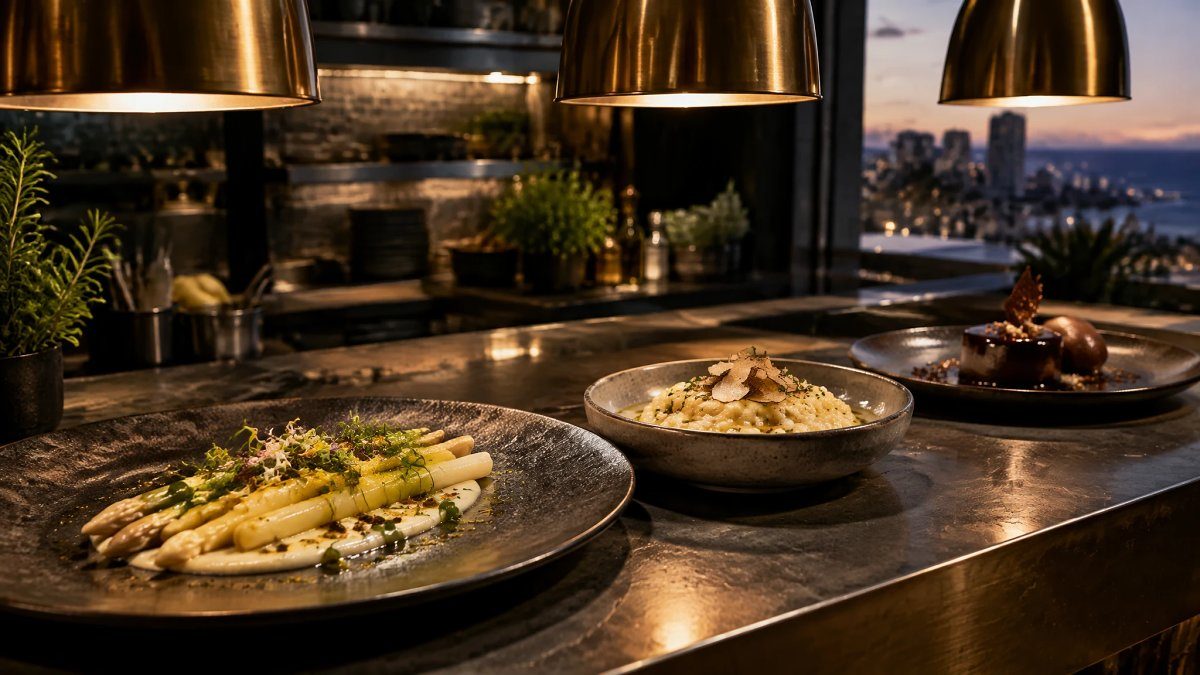
- Nomi, David Intercontinental hotel, Tel Aviv (reported May 2019). Yoram Nitzan headed a seafood-led, uncertified kitchen at the Tel Aviv port until 2015. At Nomi, Tablet reported a risotto made creamy with mashed sunchokes in place of butter and cream, a short-rib burger with smoked goose crumble, and a pareve chocolate dessert.
- Balkan, central Tel Aviv (reported May 2019). Eyal Lavi, previously known for an uncertified bistro, put his name on this kosher fish and dairy eatery. His verdict to Tablet: 'All the ingredients are more expensive, I can't import cheeses, but I manage.' For a chalav Yisrael diner, the cheese board is where the switch shows.
- Fifty&One, Nahalat Binyamin, Tel Aviv (reported April 2026). David Tur ran this dairy pasta room as kosher-style and closed on weekends, then took a Rabbinate certificate so the courtyard could host kosher events. He told Ynetnews: 'We sold the same thing without the certificate, and now we sell it with the certificate.' For a dairy kitchen without meat, he said, certification is uncomplicated and mainly a cost.
- An unnamed Jerusalem meat restaurant (reported January 2014). The owner moved from a private Badatz to the Jerusalem Mehuderet certificate and told JewishPress.com: 'I kept my same exact Mashgiach, but I now have flexibility in choosing my Mehadrin and Badatz suppliers and products.'
The pattern for the diner is consistent across the four. Dairy menus change least when a certificate arrives, as Tur's account shows. Meat and vegetable-heavy menus change most, because supplier lists and insect rules reach every plate. A move between strict levels, as in the Jerusalem case, changes the invoices and leaves the mashgiach in place.
Mehadrin vs Rabbanut and your minhag: when the level matters
Your minhag (the inherited practice of your family or community) and your rabbi settle the question; every agency Jerusalem Local quotes, the OU and Star-K included, gives that same instruction. For families keeping an OU or Star-K standard in America, the guide reports that plain Rabbanut 'is where most families draw the line', and Rav Aryeh Leibowitz, who teaches American visitors, advises eating 'where there is Rabbanut Mehadrin or a respected private kashrut provider'. The Mehadrin vs Rabbanut choice then comes down to six checks before you book.
- Meat or dairy. Rabbi Melamed recommends mehadrin especially for meat restaurants, where the most severe prohibitions apply and cheating pays most.
- Chalav Yisrael at home. Regular Rabbanut dairy falls short of that standard: Jerusalem Local notes its milk may come from farms milked on Shabbat, and Star-K reports that unsupervised milk powder is permitted at the regular level under a ruling of Rabbi Zvi Pesach Frank.
- Ashkenazi or Sephardi meat. Jerusalem Local lists Badatz Beit Yosef, founded by Rav Ovadia Yosef, as following Sephardi rulings with chalak meat.
- Glatt at home. Regular Rabbanut beef is kosher but not necessarily glatt, so a glatt household needs mehadrin or a Badatz for meat.
- The city on the certificate. Rabbinate standards differ by city, and Jerusalem Local names the Jerusalem and Rechovot mehadrin certificates as the strongest by reputation.
- Dessert and gelatin. Beef gelatin is allowed at the regular level, so mousses and set desserts deserve a question.
The level matters less for packaged goods: Jerusalem Local notes the product usually carries a second, stricter symbol. For a planned evening, such as a kosher date night in Israel or Friday night and Shabbat day in Tel Aviv, settle the level first and the short list follows.
FAQ: Mehadrin vs Rabbanut
Is Mehadrin vs Rabbanut a question for dairy restaurants too?
Yes, for anyone who keeps chalav Yisrael. Regular Rabbanut permits milk from farms that may be milked on Shabbat and unsupervised milk powder, according to Jerusalem Local and Star-K. When Jerusalem introduced its Mehuderet level in 2013, Life in Israel reported it was offered only to meat restaurants, because diners were seen as less strict about dairy. A chalav Yisrael diner still needs mehadrin or a Badatz at a dairy table.
What is the difference between mehadrin and glatt?
Glatt describes meat from an animal whose lungs were free of adhesions; it is one property of one ingredient. Mehadrin is a kitchen-wide standard that includes glatt meat, frequently chalak Beit Yosef, plus chalav Yisrael dairy, insect-controlled vegetables and closer supervision, per Jerusalem Local's 2026 comparison. A restaurant can serve glatt beef and still hold only a regular Rabbanut certificate.
Is Badatz stricter than Rabbanut mehadrin?
On several points, yes. Jerusalem Local's 2026 guide reports that the major Badatz agencies are stricter than the Rabbanut mehadrin level, each reflecting a particular community's standard. The cRc (Chicago Rabbinical Council) recommends the Eda HaChareidit, Badatz Mehadrin of Rav Rubin, Rav Landau and She'erit Yisrael among Israeli agencies. A Badatz restaurant still holds a local rabbinate certificate underneath, The Jerusalem Post reported in July 2026.
How do I check a restaurant's level before I book?
Read the certificate for issuer, level, meat or dairy status, dates and the supervisor's phone number, as Jerusalem Local advises, and call that number if anything is unclear. For Jerusalem businesses, the Religious Council's search at rabanut.org.il confirms the certificate and its level. Rabbi Melamed adds that an expired certificate calls for a call to the rabbinate, not the owner's word.
How TaamTaam helps you choose the right level
The TaamTaam concierge exists for the Mehadrin vs Rabbanut call, and it costs you nothing. Book a consultation with the TaamTaam concierge, tell us your minhag and your dates, and we return a short list matched to your standard.
Certification detail per listing. More than 143 verified kosher restaurants across 8 Israeli cities, each reporting five fields: supervising body, certification level, halav Israel status, vegetable compliance and separate meat hechsher.
Direct mashgiach access. The concierge calls the mashgiach on your behalf; kashrut details are verified independently across all major Israeli supervisors, including Rabbanut, Badatz Eda Chareidis, Badatz Beit Yosef and the OU.
Booking with the standard attached. Direct booking in the 4 cities with active coverage (Tel Aviv, Jerusalem, Caesarea and Herzliya), with restaurants reviewed by a professional food critic team.
Conclusion
The certificate level tells you how many strict opinions a kitchen has accepted, who checks its deliveries, and how often a supervisor stands at the stove. Regular Rabbanut is reliable for many diners; mehadrin adds glatt meat, chalav Yisrael, wider insect control and closed supplier lists, and the 2026 law changes who pays the person enforcing them.
Match the Mehadrin vs Rabbanut choice to your minhag before the trip, read the certificate at the door, and call the mashgiach when the paper leaves a question open.
Also worth reading:
- Reading an Israeli kashrut certificate the way a mashgiach reads it
- Kashrut literacy and mashgiach access
- A serious editor's guide to kosher date nights in Israel
- Where to eat on Friday night and Shabbat day in Tel Aviv
- Booking the arrival-night dinner in Tel Aviv
Sources:
- The Difference between Standard and Mehadrin Kashrut: Yeshivat Har Bracha, Rabbi Eliezer Melamed, 2019
- The difference between standard and mehadrin Kashrut: Israel National News, 2019
- New Jerusalem Kosher Certificate: Mehuderet: Kosher Nexus, 2014
- The Rising Stakes of Kashrut Certification: Haaretz, Naomi Darom, 2011
- How kosher are Israel's restaurants? Depends where you want to eat: Israel Hayom, 2021
- Knesset repeals 2021 kashrut reform, restores Rabbinate control over certification: The Jerusalem Post, 2026
- Kashrut in Israel Explained: Rabbanut, Mehadrin, Badatz: Jerusalem Local, 2026
- Mehadrin Hechsherim in Israel: The Inside Scoop: Star-K Kashrus Kurrents, 2006
- Rabbanut Jerusalem offers new level of kashrut, Mehuderet: Life in Israel, 2013
- Tel Aviv's Restaurant Scene Goes Kosher: Tablet, 2019
- The kosher-style restaurant trend reshaping Tel Aviv dining: Ynetnews, 2026