
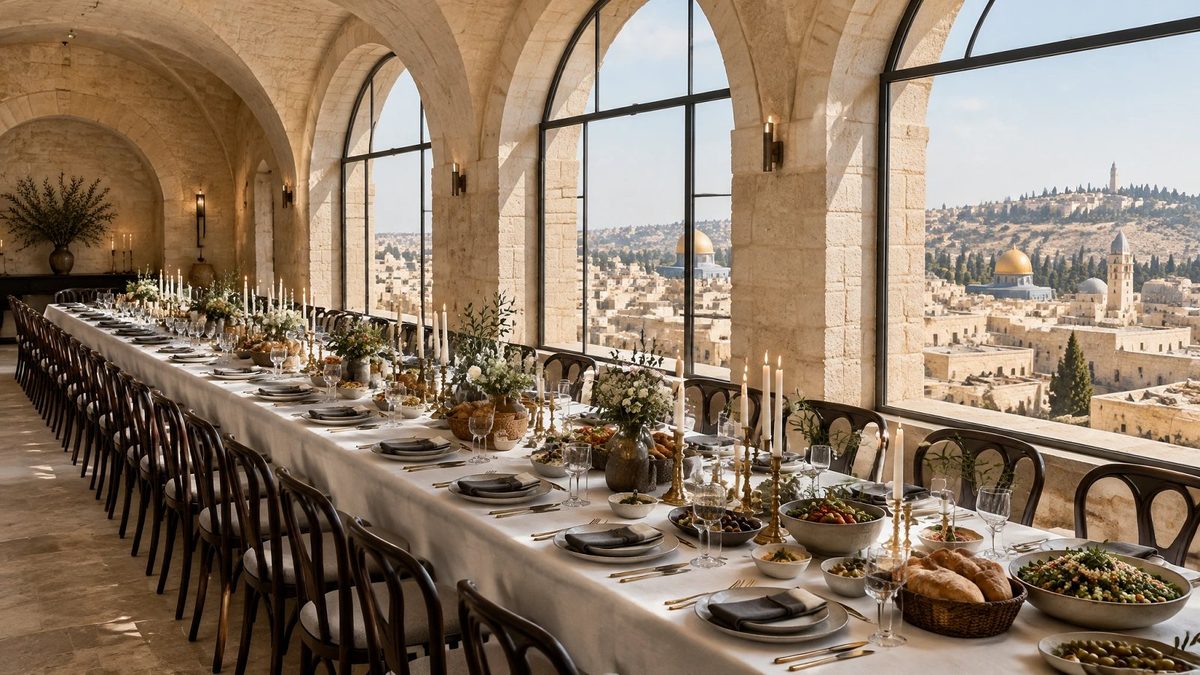
A Kotel bar mitzvah luncheon for 50 to 100 guests needs a room that seats the whole list, serves food from late morning and sits close enough that grandparents walk it after the Torah reading. Four rooms meet that brief: Culinarium in the Jewish Quarter (up to 90 seated), Lev Shalom facing the Western Wall (up to 120), Simcha Hall above the plaza (up to 70) and Lechem Basar at the First Station (up to 100). Ceremonies at the Wall run on Torah reading mornings, so the meal starts between late morning and early afternoon. The ranking below weighs capacity, hechsher (the kashrut certificate and the body that issues it), how each quote is built and the view your photographer gets. The sections after it cover the four details that decide whether the meal feels like an event: early seating, the sound floor under the speeches, booth versus banquette, and high-chairs.
Key takeaways:
- Western Wall bar mitzvah ceremonies take place on Mondays, Thursdays, Rosh Chodesh and Chol Hamoed; Foundation guides assist from 7 AM to 1 PM (2026).
- Culinarium requires a minimum of 30 guests for its dairy brunch or meat chef's meal; its two halls seat 90 and 70.
- Below 50 dB(A) (A-weighted decibels) of background noise, adults over 60 with moderate to severe hearing loss still follow conversation (2022 study).
- Lechem Basar opens at 12:00 Sunday to Thursday and takes up to 100 guests, 30 in its VIP room (2026).
The four rooms ranked for a Kotel bar mitzvah luncheon
Jerusalem's main tourism directory lists 33 bar and bat mitzvah venues, most of them hotels, museums and restaurants in the modern city. The four below keep the meal within a short walk or ride of the plaza.
Culinarium ranks first for a dairy brunch of 50 to 90 guests because it names its kashrut per menu on its own event page. The dairy brunch carries Mehadrin (the stricter supervision tier, with tighter rules on sourcing and on the presence of the supervisor) from Badatz Agudat Yisrael, a Badatz being a private rabbinical court certification. The meat chef's meal is Mehadrin under Badatz Yoreh De'ah (Rav Machpud).
| Room | Distance from the Wall | Seated capacity | Kashrut on record | Menu format | View for photos |
|---|---|---|---|---|---|
| Culinarium | 5 minutes on foot | 90 (Ancestral Hall), 70 (Kings Hall) | Mehadrin, Badatz Agudat Yisrael (dairy) or Badatz Yoreh De'ah (meat) | Dairy brunch or meat chef's meal, 30 guests minimum | Temple Mount and Mount of Olives from both floors |
| Lev Shalom | A few minutes on foot | 120 (hall), 140 (rooftop), 50 (Lev Simcha) | Rabbanut (Chief Rabbinate) supervision, Mehadrin on request | Buffet or plated; outside kosher caterers allowed | Western Wall panorama |
| Simcha Hall | Above the plaza, HaKotel Street 12 | 70 indoors | Strictly kosher caterers; certificate to confirm | Dairy brunch with hot stations | Faces the Western Wall |
| Lechem Basar | First Station, David Remez Street 4 | 100 (full room), 30 (VIP room) | Mehadrin meat | Meat menu from 12:00 | Old Jerusalem train station site |
Lev Shalom ranks second and is the only one of the four past 100 seated guests, with a rooftop for 140 and golf carts through alleys cars cannot enter. Simcha Hall ranks third: it is the closest room to the plaza, with a large video screen and audio equipment, but it caps at 70 and its event page names no supervising body, so ask the concierge to read you the certificate. Lechem Basar ranks fourth for families who want meat and a lower price point; it sits outside the walls, so book a shuttle.
For a smaller weekday table outside the Old City, our anniversary tables in Jerusalem worth the drive from Tel Aviv list rooms that also take private bookings.
Kotel bar mitzvah luncheon budget: how the four quotes are built
None of the four publishes a per-head price on its event page in October 2026, so the honest comparison is structural. Three budget bands follow from it:
- Restaurant menu band. Lechem Basar prices from its own Mehadrin meat menu, sold as an everyday restaurant at affordable prices.
- Room plus outside caterer band. Lev Shalom lets you bring an approved kosher caterer into its kitchen against a service fee.
- All-inclusive venue band. Culinarium quotes per menu above a 30-guest minimum, and Simcha Hall bundles its partner caterers into one quote; both add photography, music or transport as line items.
How do you ask for an early seating without it being awkward?
State the end time of your ceremony in writing when you ask for the room; a venue manager reads that as logistics and plans the kitchen around it. Western Wall ceremonies take place on Torah reading days only: Mondays, Thursdays, Rosh Chodesh (the first day of the Hebrew month) and Chol Hamoed (the intermediate days of Sukkot and Passover). The free shuttle for bar mitzvah families leaves Jaffa Gate every 20 minutes between 08:20 and 13:40 on Mondays and Thursdays, which sets the window your guests travel in.
- Give the venue your aliyah time. The aliyah is the call-up to the Torah. A manager plans staff around "the Torah reading ends at 10:30", where "early" alone gets you the default slot.
- Ask for the room set 30 minutes before arrival. The buffet should be stocked and the tables dressed when the first grandparent walks in.
- Check the opening hour against the menu. Lechem Basar opens at 12:00 Sunday to Thursday; a seating before noon is a private event request.
- Confirm exclusivity. A second party in the same space changes the noise and the service.
- Put the answer in the contract. The seating time belongs on the signed quote.
The sound floor and what it does to the speeches
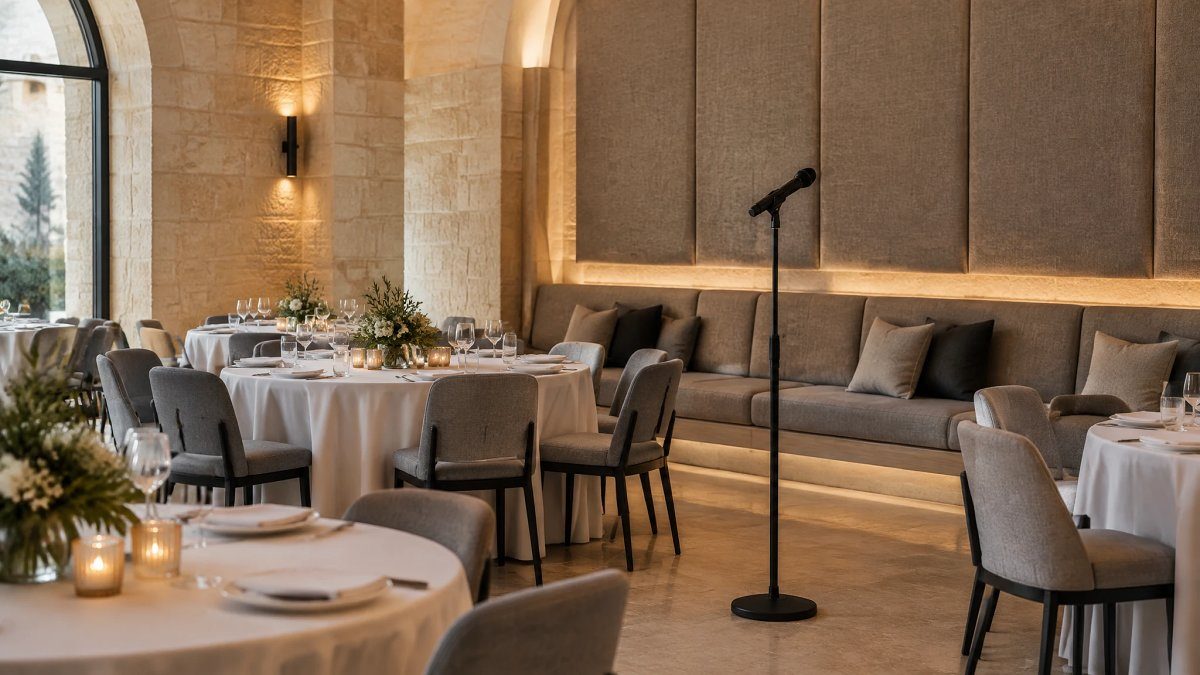
The sound floor decides whether your son's dvar Torah (the short talk on the week's Torah portion) lands or dissolves into cutlery noise. Restaurant acoustics research gives a usable number: in a 2022 study of adults over 60, background noise lower than 50 dB(A) let listeners keep their vocal effort low and follow conversation, including those with moderate to severe hearing loss. "By setting a limit, it will also keep perceived disturbance low and willingness to spend time and money high among dining patrons," write Pasquale Bottalico and co-authors of the University of Illinois Department of Speech and Hearing Science. Typical rooms run far louder. Of 1,788 New York restaurants measured through crowd-sourced readings, 25% exceeded 81 dBA, a level that forces diners to raise their voices. In a 30-restaurant survey in Orlando, only 23% stayed at 60 dBA, quiet enough to talk without shouting. For the speeches, a private hall with its own audio system matters more than an extra course.
Simcha Hall lists audio equipment and Lev Shalom lists audio facilities; ask Culinarium and Lechem Basar whether a microphone comes with the room. In a national survey of 4,085 adults run in June 2021, 64.8% said they were likely to avoid a noisy restaurant, and the grandparents at your table belong to the age group most bothered by it.
Booth or banquette: the seating call that decides the meal
A banquette is upholstered bench seating fixed along a wall and paired with movable tables; a booth is enclosed on three sides with a fixed table. Booths seat the same number of guests in 25 to 30 percent less floor space and absorb sound between parties, and families prefer them because children sit against the wall. For a bar mitzvah the drawback is size: a fixed booth cannot stretch to seat a family of nine.
The three event halls seat you at freestanding tables you configure; Lechem Basar mixes shared tables, intimate corners and a bar area. Put the bar mitzvah boy and his grandparents on the wall-side bench facing the room, so the speeches travel toward them, and seat young children on the inside of the bench where they cannot slip into the service aisle. For a room that handles three generations well on other occasions, see our guide to where observant families eat well together in Israel and the Jerusalem picks in where locals take their kids on a Thursday night.
How TaamTaam books the room and confirms the high-chairs
TaamTaam's free concierge books the room for you and calls the venue and the mashgiach (the kashrut supervisor on site) directly.
Room shortlist. We cover 143 verified kosher restaurants across 8 Israeli cities, Jerusalem included, and match the shortlist to your head count and menu.
Kashrut check. Each listing records the supervising body, the certification level, the halav Israel status (dairy milked under Jewish supervision) and vegetable compliance, verified across the Rabbanut, Badatz Eda Chareidis, Badatz Beit Yosef and the OU (Orthodox Union).
High-chairs and seating plan. We call the venue before the date to confirm how many high-chairs and booster seats the room holds, where the stroller line goes and which seats face the speeches.
Send your date, head count and ceremony time through the TaamTaam concierge booking form and we return a confirmed room. Planning a later celebration as well? Our guide to hosting sheva brachot in Tel Aviv when the budget is real uses the same method.
Kotel bar mitzvah luncheon: what to lock in the first week
Register the ceremony date with the Western Wall Heritage Foundation first, because the room booking hangs on it and the Foundation assists families at no charge. Then confirm, in this order, the seating time, exclusive use of the room, the hechsher on the signed quote and the high-chair count. Book a Kotel bar mitzvah luncheon in that order and the room is set and certified before your guests arrive from the plaza.
Also worth reading:
- Where observant families actually eat well together in Israel
- Where Jerusalem locals actually take their kids on a Thursday night
- Anniversary tables in Jerusalem worth the drive from Tel Aviv
- Where to host sheva brachot in Tel Aviv when the budget is real and the room is small
Sources:
- Bar Mitzvah at the Kotel : The Western Wall Heritage Foundation, accessed October 2026
- Bar Mitzvah Venue Near the Western Wall : Culinarium, accessed October 2026
- About Lev Shalom Events Hall : Lev Shalom, accessed October 2026
- Simcha Hall at the Kotel : Simcha Hall, accessed October 2026
- Private Events : Lechem Basar Jerusalem (Meat and Eat), accessed October 2026
- Lechem Basar Jerusalem listing : Easy.co.il, accessed October 2026
- Lombard effect, intelligibility, ambient noise, and willingness to spend time and money in a restaurant amongst older adults : Scientific Reports, April 2022
- Study Shows Noisy Restaurants Pose Health Risks : The Hearing Journal, January 2022
- Restaurant Booth vs. Table Seating : NineGuides, March 2026
- Venues for Bar/Bat Mitzvah in Jerusalem : iTravelJerusalem, accessed October 2026