
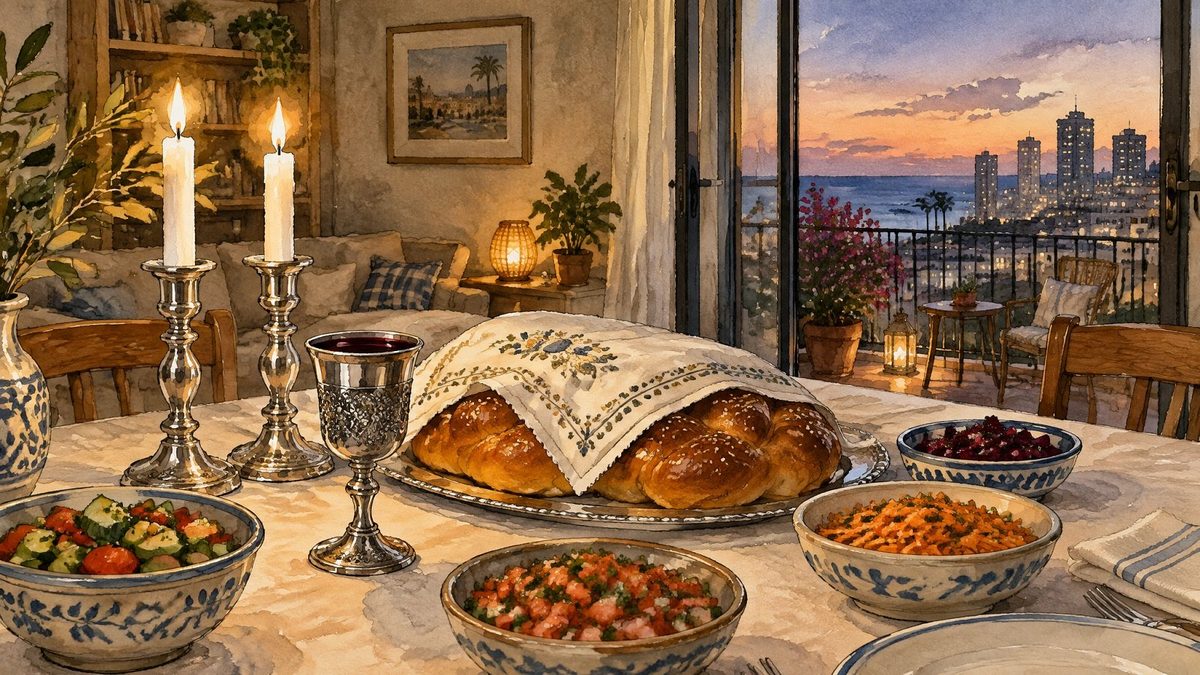
A Shabbat dinner with an Israeli family is a Friday-night meal in a private home, opened by candle lighting, the blessing over wine and the blessing over challah, and booked through a hosting program instead of a restaurant. This guide compares four programs: Delicious Israel and Tourist Israel in Tel Aviv, Betzavta across the country, and EatWith hosts such as Osnat and Rabbi Shaul in Jerusalem. Tourist Israel gives the quickest answer: its chef-led Tel Aviv table runs every Friday, seats a maximum of 12 participants and lasts about three hours, from 19:00 to 22:00. For an observant guest the deciding question is kashrut, and the programs answer it in very different words. This guide sets each program's own kashrut wording side by side, prices what can be priced, and names the hotel fallback for the Friday when every host table is full.
Key takeaways:
- Delicious Israel states that its Tel Aviv home dinners are “served Kosher style, but are not licensed Kosher”; the evening lasts 3 hours.
- Tourist Israel caps its Friday table at 12 participants and states that the meal “is not prepared in a kosher kitchen”, while containing no non-kosher ingredients.
- Shabbat of a Lifetime reports a network of 200+ host families in Jerusalem and more than 150,000 guests seated to date.
- Every full-service kosher hotel in Tel Aviv holds standard Rabbanut certification, according to a JRM Hotels audit dated 1 October 2026; Jerusalem counts 10 mehadrin-tier hotels.
What a Shabbat dinner with an Israeli family includes, from candles to grace
The evening follows a fixed order that every program on this list keeps, whatever its kitchen standard. Candles are lit 18 minutes before sundown, the moment that formally opens Shabbat, according to travel writer Trisha Velarmino of PS I'm On My Way, who attended many such dinners while living in Israel. At the table the host recites Kiddush, the blessing over wine that sanctifies the day, and My Jewish Learning advises guests to “watch your host for the cue to sip it.” Netilat yadayim, the ritual washing of hands from a two-handled cup, comes next. Many observant diners stay silent from the washing until HaMotzi, the blessing over the two challah loaves. The meal itself runs two to three hours across the programs below. It closes with Birkat Hamazon, the grace after meals, which takes about five minutes according to My Jewish Learning, and in many homes with zemirot, the Shabbat table songs, which Rabbi Shaul's Jerusalem guests follow with transliterations.
Logistics shape the booking before the menu does. A shomer Shabbat guest (one who keeps the laws of Shabbat) will not ride home after candle lighting, and Israeli public transport stops for Shabbat in any case. The host's address therefore has to sit within walking distance of your hotel, and payment, confirmation and directions all have to close before Friday afternoon.
Which Shabbat dinner with an Israeli family fits a kosher-keeping guest?
The answer depends on the hechsher (the kashrut certificate) you hold by at home. A mehadrin standard, the enhanced tier above regular Rabbanut supervision, typically means Chalav Yisrael dairy (milk supervised from milking), glatt meat and a mashgiach (kashrut supervisor) on site whenever the kitchen operates, according to JRM Hotels. Neither Tel Aviv program on this list holds a kashrut license, by its own statement. A guest who eats only under a recognised hechsher should book an observant Jerusalem home and confirm the meat supplier in writing, or take the hotel route described further down. A guest from a traditional home who keeps kosher style has the full list open. Our guide to planning an observant trip to Israel with the rigor of a concierge covers the wider Shabbat calendar.
Four host programs compared on kashrut, table size and price
The table below quotes each program's kashrut position in its own words, because that wording decides whether an observant visitor eats the meal or only attends it.
| Program | City | Format | Table size | Kashrut, in the program's words | Price signal |
|---|---|---|---|---|---|
| Delicious Israel | Tel Aviv | Private dinner in a host family's home, 3 hours | Private booking | “Kosher style, but are not licensed Kosher” | On request |
| Tourist Israel | Tel Aviv | Chef-led 5-course dinner, 19:00 to 22:00 | Maximum 12 participants | “Not prepared in a kosher kitchen”, no non-kosher ingredients | On request |
| Betzavta | Across Israel | Matched dinner at a non-professional host's home | One matched household | No certification published | Guest covers the ingredients |
| EatWith, Osnat and Rabbi Shaul | Jerusalem | Communal Friday dinner with yeshiva students | Up to 25 guests (host interview, 2019) | Confirm the hechsher with the host | €161 per guest (October 2026) |
| Shabbat of a Lifetime | Jerusalem | Network of host families | 200+ host homes | Confirm per host | On request |
Published prices give a working range. PS I'm On My Way, updated in September 2025, listed EatWith dinners in Tel Aviv from $104 for 2.5 hours and in Jerusalem from $128, with a lighter dinner-and-drinks format from $54. A family of four booking the Jerusalem table at the October 2026 rate of €161 per guest would therefore pay €644 before transport.A Shabbat dinner with an Israeli family through Delicious Israel or Tourist Israel is quoted on request; ask for the adult and child price in the same email.
Delicious Israel's host family program in Tel Aviv
Delicious Israel seats guests at a real family's table, which makes it the natural first call for a Shabbat dinner with an Israeli family in Tel Aviv. The Delicious Israel Shabbat dinner page describes a three-hour Friday night “in a family's home in Tel Aviv”, opened with the blessings over wine and challah and followed by “a menu creatively crafted to demonstrate Israel's culinary gems.” The program names three target guests: families who want Shabbat “in a private setting outside of their hotel or a restaurant”, visitors who want a casual family setting, and food lovers.
Inbal Baum, founder of Delicious Israel, explained the matching philosophy to NoCamels in April 2019: “We don't really match people. We want it to be a random mix.” She added that the program had more requests from visitors than homes available, which makes early booking the first rule. Booking runs through a contact form instead of an instant calendar, and the page publishes no price.
The kashrut line is explicit: the dinners are “served Kosher style, but are not licensed Kosher.” For a guest who eats only under a hechsher, that wording settles the question. For a traditional family that wants a warm, secular-leaning Tel Aviv table, it is the most personal format on this list.
Tourist Israel's chef-led Friday table in Tel Aviv
Tourist Israel, which presents itself as “Israel's Largest Travel Company”, runs the most predictable format. The Tourist Israel Tel Aviv Shabbat dinner listing promises a 5-course meal with wine, cooked by “an expert local chef”, every Friday from 19:00 arrival to a 22:00 close, in English, for a table “limited in space to only 12 participants.” The menu fuses Shabbat dishes from the Jewish diaspora with modern Israeli food: challah, baba ganoush, mahshi (stuffed vegetables) and malabi (a rose-scented set pudding).
The guests are a mix of locals and visitors, Jewish and non-Jewish, and the evening includes candle lighting plus an explanation of Shabbat customs. The host is a chef rather than a family, so the experience reads as a hosted supper club with ritual. On kashrut, the listing states that “the meal is not prepared in a kosher kitchen however does not include any non-kosher ingredients.” Observant visitors who need a certified Friday meal in the city should read our list of where to eat on Friday night and Shabbat day in Tel Aviv instead.
Betzavta and the smaller, matched home table
Betzavta, Hebrew for “together”, books a Shabbat dinner with an Israeli family by matching each guest party with a single host household. Software engineers Niv Saar and Ori Pearl founded it in February 2017, and some 600 guests had been hosted by April 2019, according to NoCamels. Hosts are non-professionals, guests pay for the ingredients, and Saar describes the method plainly: “We are trying to focus on the quality of the match.” He looks for shared ground between both sides, such as a vegan diet or the same line of work.
The testimonials Betzavta publishes carry the appeal. Elysia, from Washington, DC, wrote: “I fell in love with Israel all over again after having dinner in Tel-Aviv with five of the kindest strangers I had ever met.” Alex, from Russia, called it “one of our best in Israel.” The press coverage dates from 2017 to 2019, and the Betzavta site failed to load during our October 2026 check, so confirm the service is taking bookings before you plan around it.
Jerusalem has a larger equivalent. Shabbat of a Lifetime places visitors with host families in the heart of the city and reports 200+ hosts, more than 150,000 guests and visitors from 88+ countries. Ask which host family you are matched with and which hechsher its kitchen follows.
EatWith and the global platform alternative
EatWith, founded in 2012 by Israelis Guy Michlin and Shemer Schwartz, operates in more than 130 countries, according to NoCamels. In Israel, home cooks and chefs post dated dinners, guests must book in advance, and a table can mix visitors with Israelis.
A long-running Jerusalem Shabbat listing belongs to Osnat and her husband Rabbi Shaul, who began hosting almost 35 years before their 2019 EatWith interview. The couple told EatWith: “we host 40-45 people every Shabbat. We are able to welcome 25 guests.” Yeshiva students help with the singing. Lamb, Moroccan fish and homemade challah anchor the menu. The couple attend synagogue first: “We don't pray here. We come back after the prayers.” Their October 2026 listing showed €161 per guest. Before paying, use the listing's “Contact the host” option to confirm the hechsher, the meat supplier and the walking route from your hotel. Our plan for a Shabbat in Jerusalem from Friday afternoon to Saturday night maps the restaurant side of the same weekend.
The hotel Shabbat table when every host is booked
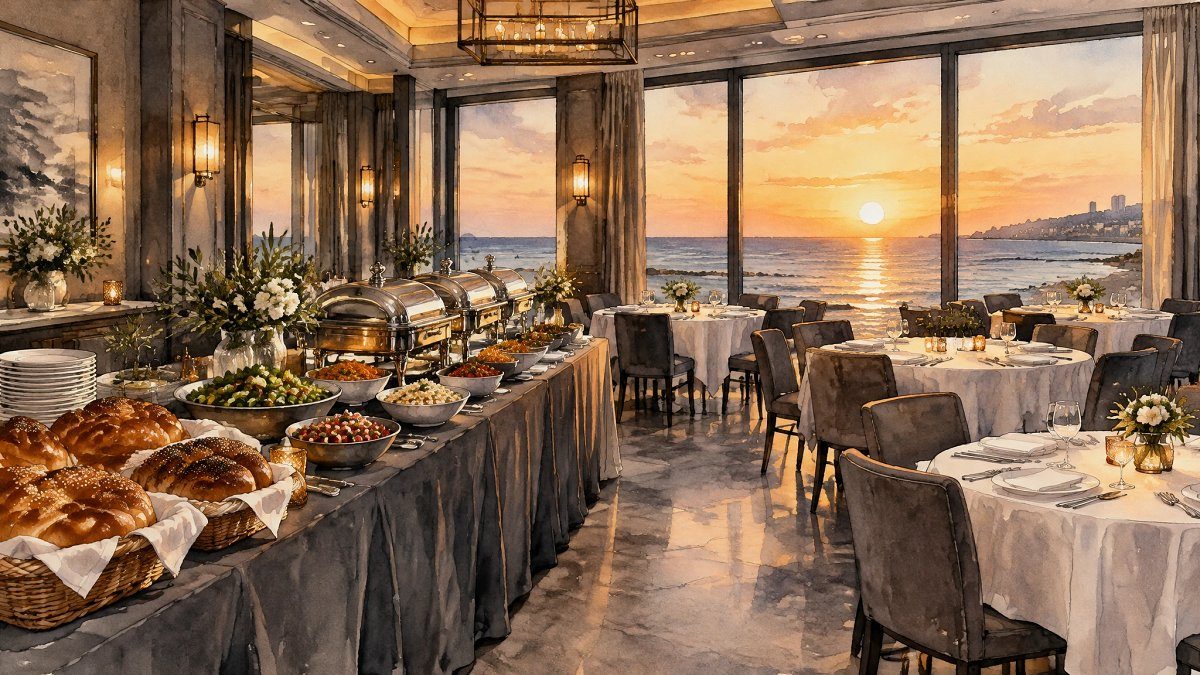
A large kosher hotel seats hundreds of diners on a Friday night, and for strict kashrut it offers a certificate you can check at the door. Every full-service kosher hotel in Tel Aviv holds standard Rabbanut certification, and no whole-hotel mehadrin operation exists there, according to the JRM Hotels audit of 1 October 2026. Jerusalem counts 10 mehadrin-tier hotels in the same audit, among them Prima Kings (Rabbanut Yerushalayim, Glatt Mehadrin) and Jerusalem Gate (Badatz Mehadrin Rabbanut Yerushalayim with OU, 298 rooms).
The Hilton Tel Aviv shows how a Rabbanut hotel serves a stricter guest. Food writer Jamie Geller described her August 2019 Shabbat there: before arrival she “spoke to the Mashgiach and special ordered Mehadrin chicken and meat.” The hotel synagogue drew over 100 worshippers, the Cafe Med Friday buffet seated over 500 diners across more than 30 salads, and the meal ran until after 11 pm. The hotel also operates a Shabbat elevator (a lift that stops automatically on every floor), though Geller asked for a low floor because her family does not use one. Families with young children will find more hotel options in our guide to Shabbat with children in hotel restaurants.
Etiquette for a Shabbat dinner with an Israeli family: dress, gifts and timing
Seven points separate a welcome guest from an awkward one. Each comes from a named guide.
- Ask about kashrut before choosing a gift. Rabbi Shraga Simmons of Aish writes: “The safest thing is flowers, or wine if you're familiar with your hosts standards of kashrut.”
- Bring flowers already arranged in water. PS I'm On My Way recommends presenting them in a vase that is already filled, since an observant host will not fill a vase on Shabbat.
- Pick sealed, certified sweets. Strict hosts prefer desserts sealed in their original packaging, per the same guide, and My Jewish Learning adds that a meat meal rules out any dairy gift.
- Dress modestly and one notch formal. Women: skirts at or below the knee, collarbone and elbows covered. Men: a kippah, with spares on hand at most tables, according to PS I'm On My Way. Velarmino advises erring toward the more formal and more modest outfit whenever in doubt.
- Arrive on time for the host's schedule. Aish puts the best arrival for staying guests at “45-60 minutes before candle-lighting”; Tourist Israel seats its table at 19:00.
- Leave the phone and the light switches alone. My Jewish Learning: knock instead of ringing the doorbell, take no pictures, and leave lights as you find them.
- Send dietary needs ahead. Aish asks guests to flag allergies and vegetarianism before Friday so the host cooks for them.
A call or message after Shabbat ends, naming a dish you loved, closes the evening properly, as Aish recommends.
FAQ: Shabbat dinners with Israeli hosts
Is a Shabbat dinner with an Israeli family kosher?
It depends on the program, and each publishes its own wording. Delicious Israel serves its Tel Aviv dinners “Kosher style, but are not licensed Kosher.” Tourist Israel states its meal “is not prepared in a kosher kitchen” although it contains no non-kosher ingredients. Betzavta publishes no certification. Observant Jerusalem homes, such as Osnat and Rabbi Shaul on EatWith, fit a kosher-keeping guest best; ask for the hechsher and the meat supplier in writing before you pay.
How much does a Shabbat dinner with locals cost in Israel?
Published prices run from about $54 to €161 per guest. PS I'm On My Way, updated in September 2025, listed EatWith dinners in Tel Aviv from $104 and in Jerusalem from $128, plus a dinner-and-drinks format from $54. The Osnat and Rabbi Shaul table in Jerusalem showed €161 per guest for October 2026. Delicious Israel and Tourist Israel quote on request, so ask for the adult and child price together.
How far ahead should I book a Friday-night host?
Book as soon as your Friday is fixed. Tourist Israel caps its table at 12 participants and recommends early booking. Inbal Baum, founder of Delicious Israel, told NoCamels in 2019 that her program receives more requests from visitors than it has homes available. Payment, confirmation and directions must close before candle lighting, because a Shabbat-observant guest will not handle money or a phone once Shabbat begins.
Can I attend if I keep Shabbat and stay in a hotel?
Yes, provided the host's home sits within walking distance of your hotel. Israeli public transport stops for Shabbat and a shomer Shabbat guest will not take a taxi back, so confirm the street or neighborhood before you pay. On EatWith, the “Contact the host” option handles that question. If no host lives close enough, the hotel's own Friday dinner keeps you inside the building, with a synagogue on site at hotels such as the Hilton Tel Aviv.
How TaamTaam helps you plan the Friday night
TaamTaam covers the meals around the host dinner and the kashrut questions inside it, free of charge.
Verified kosher tables. The directory lists 143+ verified kosher restaurants across 8 Israeli cities, with active coverage in Tel Aviv, Jerusalem, Caesarea and Herzliya. Use it for the Thursday dinner before your hosted Friday and for the motzaei Shabbat meal (Saturday night, once Shabbat ends) after it.
Certificate-level detail. Each listing reports the supervising body, the certification level, Chalav Yisrael (Halav Israel) status, vegetable compliance and any separate meat hechsher, checked across the Rabbanut, Badatz Eda Chareidis, Badatz Beit Yosef, OU and other supervisors.
A free concierge. The TaamTaam concierge books tables directly and calls the mashgiach for you before Friday. Start with our Shabbat dining guide for Israel to choose the meals that sit around a Shabbat dinner with an Israeli family.
Conclusion
The four host programs answer four different needs. Delicious Israel offers a private family home in Tel Aviv under a kosher-style kitchen, Tourist Israel a fixed chef's table of 12, Betzavta a matched household, and EatWith an observant Jerusalem table at a published price. The hotel dinner remains the dependable fallback for strict kashrut. Decide your kashrut line first, then book a Shabbat dinner with an Israeli family that sits within walking distance of your bed.
Also worth reading:
- Where to eat on Friday night and Shabbat day in Tel Aviv
- A Shabbat in Jerusalem from Friday afternoon to Saturday night, planned
- Spending Shabbat and chag in Israel without losing the rhythm
- Planning an observant trip to Israel with the rigor of a concierge
Sources:
- Delicious Shabbat Dinner: Delicious Israel, consulted 2026
- Tel Aviv Shabbat Dinner Experience: Tourist Israel, consulted 2026
- Social dining initiatives serve up Israeli hospitality: NoCamels, 2019
- Betzavta testimonials: Betzavta
- Shabbat dinner with locals in Israel: PS I'm On My Way, 2025
- Experience Shabbat With Dinner In Jerusalem: EatWith, 2026
- The secret to a magical Shabbat dinner with host Osnat: EatWith, 2019
- Shabbat of a Lifetime: Shabbat of a Lifetime
- My Shabbat experience at the Hilton Tel Aviv: Jamie Geller, 2019
- Mehadrin hotels in Israel: JRM Hotels, 2026
- How to be a good Shabbat guest: Aish
- How to be a fabulous Shabbat dinner guest: My Jewish Learning