
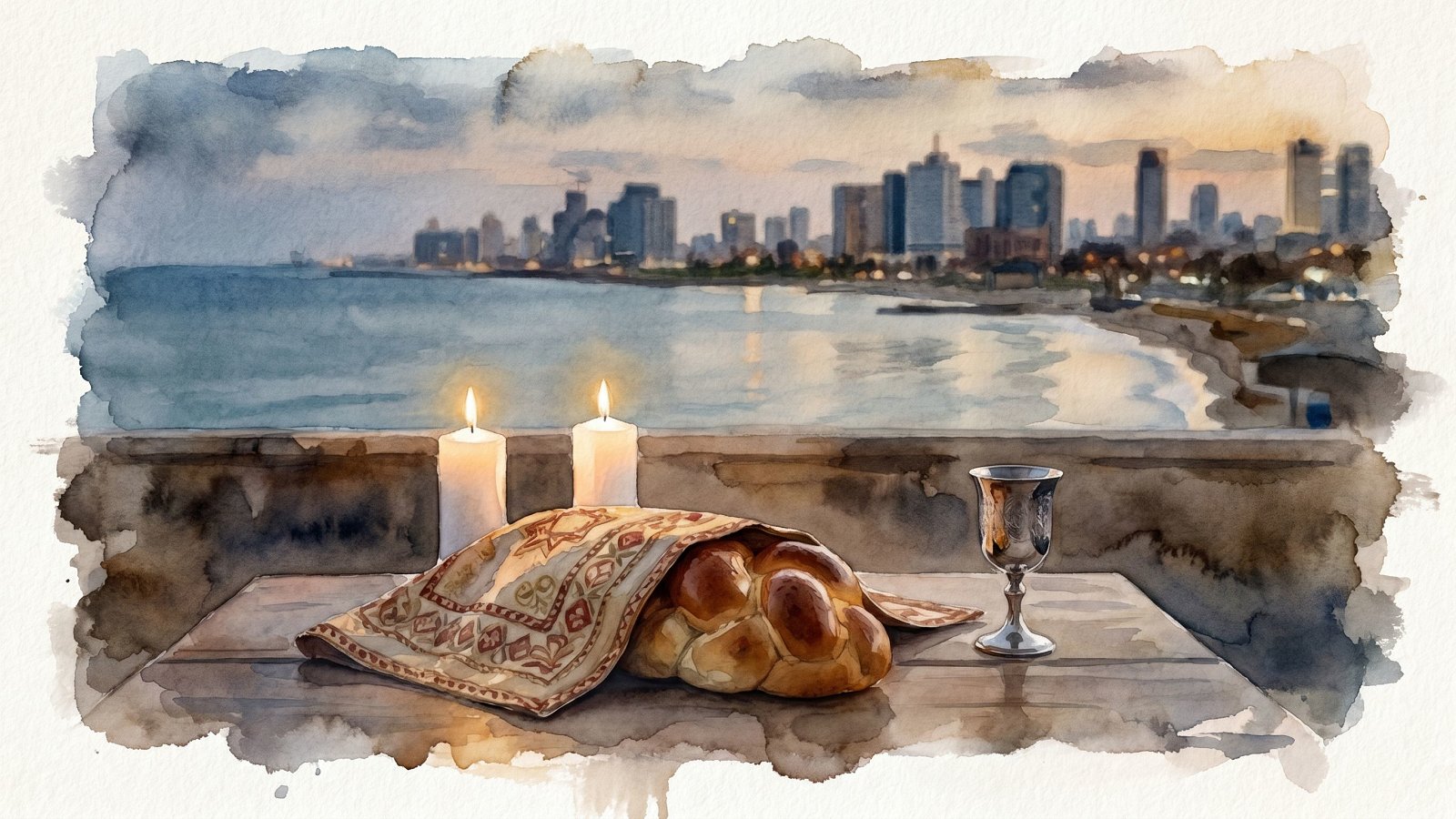
Spending Shabbat away from home Israel is a different exercise from keeping Shabbat where you live, and the difference is logistics, not halacha. Israel drew 1.3 million tourists in 2025, half of them Jewish, and they stayed an average of nine days and spent 1,622 dollars excluding flights, according to the Israel Ministry of Tourism. Many of those nine-day trips contain at least one Shabbat and sometimes a three-day chag. This hub is the map for a Shabbat away from home Israel: where observant diners actually eat on Friday night, how a Jerusalem Shabbat unfolds hour by hour, when a hotel Yom Tov (festival day with Shabbat-like restrictions) program earns its price, and how to book it all without touching a phone after candle-lighting.
Key takeaways
- Most independent kosher restaurants in Israel close before candle-lighting and reopen only after Shabbat ends, so a Friday-night seat almost always means a hotel dining program or a pre-booked private table.
- Candle-lighting custom differs by city: Jerusalem lights 40 minutes before sunset, Tel Aviv around 18 to 20 minutes, Haifa around 30 minutes (Chabad and Jerusalem Post weekly tables, 2026).
- The electronic hotel key card is muktzah (an object that may not be handled on Shabbat); request a mechanical Shabbat key and a low floor or a Shabbat elevator when you book, per the STAR-K Traveler's Halachic Guide to Hotels.
- A hotel Friday-night buffet runs roughly 220 to 420 shekels per adult; a private Old City experience such as Shabbat of a Lifetime was reported at 335 dollars for a family of five.
- TaamTaam verifies 143-plus kosher restaurants across eight Israeli cities, reporting the supervising body, certification level, and Halav Israel status per listing, and its free concierge books the table and calls the mashgiach for you.
What this Shabbat away from home Israel hub covers, and what each fiche goes deeper on
This page is a reference, not a listicle. It sequences every editorial route inside one Shabbat or chag spent away from your own kitchen, and it hands each route to a dedicated article when you are ready to go deeper. The promise is simple: land here, find the sub-intent that matches your trip, and leave with a plan and a booking, not a list of restaurant names you still have to vet.
What it covers: Friday-night and Shabbat-day dining in Tel Aviv, a full Jerusalem Shabbat from Friday afternoon to Saturday night, booking a Shabbat table with an Israeli family, the motzaei Shabbat (the hour after Shabbat ends on Saturday night) dinner in Tel Aviv, choosing a Jerusalem festival hotel program, keeping Shabbat with children at a hotel, the three-day Yom Tov, a Galilee boutique option, and the small mechanics of candle-lighting and havdalah (the blessing over wine, spices, and a flame that closes Shabbat). What it leaves to the fiches: the deep per-venue detail, the exact seating policies, and the neighbourhood-level walking notes, each of which lives in its own linked article below. Read this hub as the decision layer for Shabbat away from home Israel, and treat each fiche as the booking layer underneath it.
If this is your first such trip, start one level up with your first trip to Israel as an observant traveler, planned the right way, then return here for the Shabbat-specific apparatus.
Friday night and Shabbat day in Tel Aviv: where observant diners actually eat
Tel Aviv is the city where the gap between the secular calendar and the observant one is widest, and that gap defines the dining problem. The vast majority of independent kosher restaurants shut on Friday afternoon and reopen on Saturday night, a pattern Plan it Israel documents in its Tel Aviv kosher guide and the Tripadvisor Tel Aviv forum confirms thread after thread. The reliable Friday-night seat is therefore the continuous-service hotel dining room, and three names recur: Katzir at The David Kempinski, Aubergine at the David InterContinental, and the Royal Beach.
Katzir, the mehadrin (a stricter standard of kosher supervision) restaurant inside The David Kempinski Tel Aviv, serves its Friday Shabbat dinner from 19:00 to 21:30 and Shabbat lunch from 13:30 to 15:30, with the evening seating moving by season to follow candle-lighting. Chef Daniel Raymond builds the meat menu around Israeli regional cooking, and the room looks straight at the Mediterranean. Gil Travel, in its Shabbat in the Holy Land guide, frames the category plainly: luxury hotels in Israel pride themselves on serving gourmet Shabbat dinners and are experts at tailoring their arrangements to meet guests' needs.
Shabbat day in Tel Aviv has its own texture. The beach fills, the secular city brunches, and the observant traveler moves between the hotel lunch seating, a slow afternoon, and seudah shlishit (the third Shabbat meal, eaten late afternoon). The Crowded Planet's Shabbat in Tel Aviv guide captures the wider mood, that on Friday the only dead hours run from roughly 15:00 until the city wakes again after dark. Planning Shabbat away from home Israel in Tel Aviv means booking the hotel table a week out and treating the in-between hours as the point, not the gap.
The table below maps the four Friday-night routes for Shabbat away from home Israel, so you can match the route to your household before you reserve, rather than discovering at 16:00 on Friday that every seat is taken.
| Friday-night route | Typical cost | When it happens | Kashrut control | Best for |
|---|---|---|---|---|
| Hotel Shabbat program | 220 to 420 ILS per adult | Seating timed to local candle-lighting | Hotel mehadrin, named supervision | First-timers, families, zero logistics |
| Booked family table | 150 to 250 ILS per guest | Fixed home dinner, paid in advance | Host-set, confirm a week ahead | Travelers wanting immersion |
| Motzaei Shabbat dinner | A la carte | After havdalah, Saturday night | Full restaurant hechsher | Couples, no clock pressure |
| Kosher takeaway | A la carte, ordered ahead | Collected before candle-lighting | Vetted venue, eaten in your room | Self-catering, late arrivals |
Shabbat day itself adds a second decision: the long lunch seating, then the slow afternoon, then seudah shlishit before the day closes. When the hotel program is not the plan, two fiches take over: where to actually eat on Friday night and Shabbat day in Tel Aviv for the full venue list, and kosher Shabbat takeaway in Tel Aviv when hotel dining is not the plan for the order-ahead route.
A Shabbat in Jerusalem, Friday afternoon to Saturday night
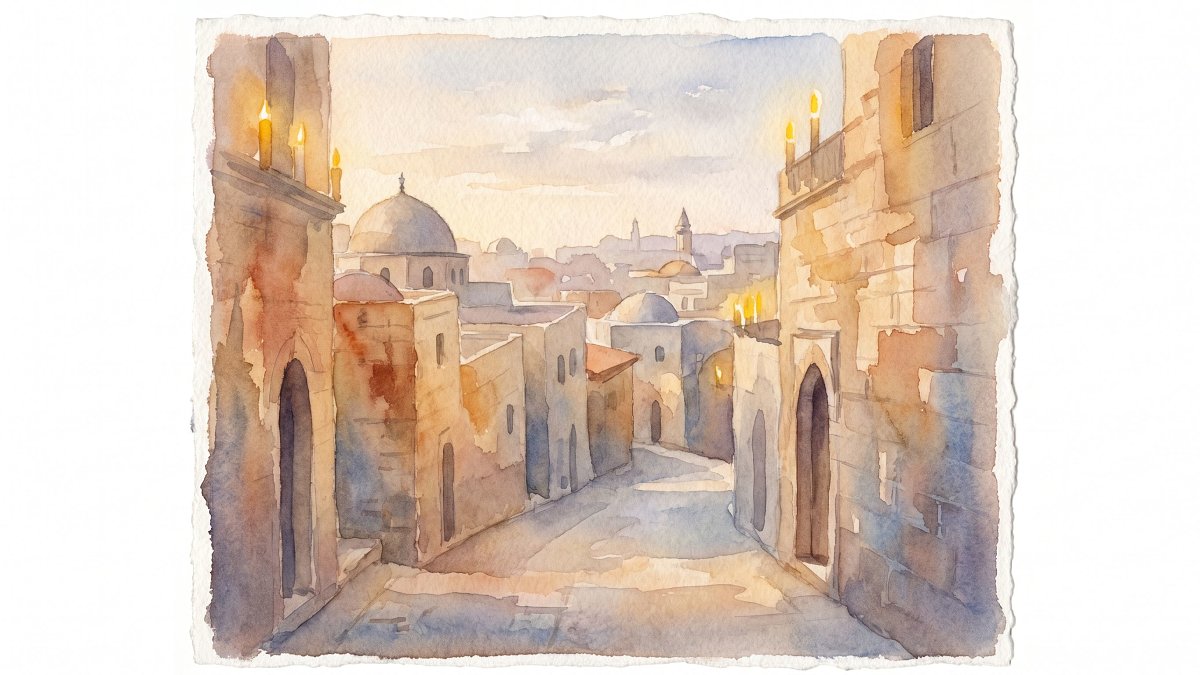
Jerusalem keeps Shabbat at the level of the whole city, and that changes the plan from damage control to immersion. The city offers 33 kosher or Shabbat-friendly accommodations, many within walking distance of the Old City, synagogues, or a Chabad house, according to Totally Jewish Travel. Friday afternoon is for arrival, check-in, and the market run on Machane Yehuda before it shutters; by mid-afternoon the rhythm has already turned inward.
The Jerusalem candle-lighting custom is the earliest in the country, 40 minutes before sunset rather than the standard 18, so the entire Friday timeline compresses. A worked example makes the stake concrete. If sunset falls at 19:10, Jerusalem candle-lighting is roughly 18:30, which means the last kosher lunch counter on Machane Yehuda has closed, the hotel front desk needs your paperwork done, and your walk to the Kotel has to be timed before, not after, you light. Build the afternoon backward from 18:30, not from sunset, and the day holds together; build it forward from a vague evening and you lose the margin. This single habit, planning to the city's candle-lighting minute, separates a calm Jerusalem Shabbat from a scramble, and it is the first thing the TaamTaam concierge confirms on any Jerusalem booking.
Friday night in Jerusalem is Kabbalat Shabbat (the service welcoming Shabbat) at a synagogue near your hotel, then the hotel dinner or a private table. Saturday runs from the morning service through the long lunch, an afternoon of rest or a walk inside the eruv (the halachic boundary that permits carrying on Shabbat), seudah shlishit, and havdalah after roughly 20:25, when three stars appear. The Old City is the natural Saturday-afternoon walk, since the Jewish Quarter sits inside the eruv and the Kotel is a short, car-free stroll from most central hotels. When Shabbat ends, Jerusalem reopens slowly, so plan a quiet motzaei Shabbat rather than the restaurant rush that defines Tel Aviv. For many travelers, a first Shabbat away from home Israel in Jerusalem is the easiest of all, because the whole city keeps the day and the margin for a timing mistake all but disappears. For the venue-level detail, follow a Shabbat in Jerusalem from Friday afternoon to Saturday night, planned. Spending Shabbat away from home Israel reaches its fullest form here, where the city does the heavy lifting and you only have to keep time.
Booking a Shabbat dinner with an Israeli family
The table that a hotel cannot replicate is a private home, and Israel has a developed market for it. EatWith hosts in Tel Aviv and Jerusalem open their Friday-night tables to visitors; one veteran Tel Aviv host, Anat, reports that about 25 percent of her Shabbat guests are not Jewish, and that the challah is baked fresh every Friday before the meal. The format is a fixed home-cooked dinner with blessings and song, booked and paid in advance so no money changes hands on Shabbat.
In the Old City of Jerusalem, Shabbat of a Lifetime runs a five-course home-cooked meal with an observant family, reported at 335 dollars for a family of five, a structured way to share a table with Jerusalemites who keep Shabbat as a matter of course. The educational value is real for a first-time visitor and the social value is real for a returning one. A typical home table runs the full arc: candle-lighting, kiddush (the blessing over wine that sanctifies the day), two challot, a fish course, soup, a main, and the singing between courses, with the children of the house often leading. Booking a family table for Shabbat away from home Israel works best when you confirm the kashrut standard and any dietary limits a week ahead, because a home kitchen is not a certified restaurant and the host sets the level.
A home table is one of the most rewarding ways to spend Shabbat away from home Israel, and the deeper route, with named hosts and neighbourhoods, lives in booking a Shabbat dinner with an Israeli family in Tel Aviv or Jerusalem.
The motzaei Shabbat dinner that earns the late hour in Tel Aviv
When Shabbat ends in Tel Aviv around 20:28, the city's kosher kitchens reopen and the best tables of the week become available to anyone who waited. Motzaei Shabbat is the observant traveler's reward, a late dinner with no clock pressure, and Tel Aviv runs it better than anywhere else in the country. The trick is the booking: the kitchens fire up only after Shabbat, so the seating you want is the 21:30 or 22:00 slot, reserved days earlier for a time that depends on havdalah, not on a fixed hour.
This is also the melaveh malkah window, the meal that escorts Shabbat out, and a growing number of Tel Aviv restaurants treat the first Saturday-night seating as an event. Because havdalah shifts week to week, the smart booking is made by name and confirmed against the date's exact end time, not pinned to a fixed clock hour that may fall before Shabbat has even ended. Spending Shabbat away from home Israel and ending it at a proper motzaei Shabbat table is the difference between enduring the day and savouring its close. For anyone spending Shabbat away from home Israel on the coast, this is the meal to plan for, and the full venue logic, with which kitchens are worth the late hour, sits in booking the motzaei Shabbat dinner that earns the late hour in Tel Aviv.
Choosing a Jerusalem Yom Tov hotel program that earns the price
A festival hotel program in Jerusalem is a different purchase from a Shabbat night, because it bundles two or three days of meals, services, and childcare into one price, and the price can be steep. The question is not whether the program is expensive but whether it earns the cost. The markers that justify it: a reliable mehadrin kitchen with named supervision, a synagogue on site or within the eruv, a Shabbat elevator and a mechanical key arrangement, a children's program that runs through the meals, and a seating plan that does not collapse when 300 guests arrive at once.
Many Jerusalem properties hold Badatz (an independent ultra-Orthodox kashrut authority) supervision and operate a hotel synagogue, mikveh, and Shabbat keys, the same apparatus Plan it Israel describes across its mehadrin hotels list. Read the program for what it guarantees in writing, not for its brochure adjectives, and ask specifically about the named supervising rabbi, the meal timetable across all festival days, and whether the children's program runs through the evening seatings. Picking a Jerusalem festival program for Shabbat away from home Israel comes down to matching the guaranteed services to your household, and the deep comparison lives in picking a Jerusalem Yom Tov hotel program that earns the price.
Spending Shabbat away from home Israel with kids, without the kids breaking
A Shabbat hotel with children is a logistics problem dressed as a holiday, and the top SERP rankers cover it in community threads but rarely write it as its own plan. The deciding factors are unglamorous: an early children's seating before the adult dinner, a quiet floor away from the lobby noise, a stroller-friendly route to the synagogue, and a room close enough to skip the Shabbat elevator at bedtime. The supporting keyword here, shabbat with kids israel hotel kosher, hides a real anxiety, that the meal the parents waited all week for becomes a 90-minute negotiation with a tired three-year-old.
The fix is sequencing. Feed the children first at the early seating, get them down before candle-lighting where the timeline allows, and stagger the adult dinner to the later slot. Hotels that run a genuine children's program through Friday night, rather than a token kids' corner, are the ones worth the premium, and the David Kempinski, Royal Beach, and David InterContinental recur in family discussions for exactly this. Spending Shabbat away from home Israel with children also means packing for the room: snacks that need no heating, a familiar toy, and a plan for the long Saturday afternoon when the pool is closed for Shabbat. The lobby board games, a quiet courtyard, and a pre-arranged nap usually carry the afternoon better than any single activity, and a ground-floor room spares you the Shabbat elevator at every nap and bedtime. The full strategy sits in spending Shabbat with kids at an Israeli hotel without the kids breaking.
Three-day Yom Tov away from home: the plan and the pack list
The hardest version of this trip is the three-day stretch, when a festival day joins directly to Shabbat and nothing reopens for roughly 72 hours. Rosh Hashanah is two festival days; the start and end of Sukkot and Pesach carry Shabbat-like restrictions, and when one of those days abuts Shabbat the result is three consecutive days with no shopping, no cooking from scratch beyond what festival law permits, and no public transport. The margin for error narrows to zero, which is why the plan and the pack list matter more here than on any single Shabbat. A three-day chag is the most demanding form of Shabbat away from home Israel, and it is the one trip where a single missed seating cannot be fixed until the festival is over.
The pack list for a three-day chag, refined from the TaamTaam Shabbat planning notes of 17 May 2026 and standard festival-travel guidance:
- Confirmed seatings for every meal. Six meals across the three days, each reserved by name, with the festival-day and Shabbat times confirmed in writing.
- Eruv and carrying status. Whether the hotel is one enclosed domain and whether the local eruv is up, so you know if a sibling can carry a child to the synagogue.
- Elevator and key. A Shabbat or Yom Tov elevator and a mechanical key, since the electronic card is muktzah for the full stretch.
- Hot water and a kettle plan. A hot-water urn or hotel arrangement on your floor, because boiling fresh is not permitted on Shabbat.
- Machzorim and ritual items. Your own festival prayer books, and for Sukkot the arba minim (the four species: lulav, etrog, hadassim, aravot) if the hotel does not supply them.
- Children's supplies. Snacks, games, and clothing for three days with no laundry and no shops.
- Medication and refills. A full supply, since pharmacies close for the whole period.
- A printed timetable. Candle-lighting, festival, and havdalah times printed, because phones are away for 72 hours.
For the full walkthrough, follow spending three-day yom tov away from home, plan and pack list.
Shabbat in the Galilee at a small boutique kosher hotel
Not every Shabbat away from home wants a 300-guest dining room. The Galilee offers the opposite register, a small boutique kosher hotel where the Friday-night table is 30 people and the singing carries. Properties such as the Villa Galilee on Mount Canaan near Tzfat, and the mehadrin Kinar Galilee on the Sea of Galilee under the supervision of the Av Beit Din of Tiberias, run real Shabbat dining rooms with traditional food and zemirot (Shabbat table songs). The trade is intimacy for scale, and for many returning visitors it is the better trade. A Galilee Shabbat also pairs naturally with a Friday-morning visit to the Tzfat artists' quarter and the ancient synagogues before the town turns inward, giving the day a sense of place that a coastal tower cannot.
The Galilee also changes the surrounding day. Tzfat, the home of Jewish mysticism, fills with a Shabbat quiet that the coastal cities cannot match, and the short distances mean the synagogue, the table, and the view are all within an easy walk. Choosing the Galilee for Shabbat away from home Israel suits the traveler who wants the day soft and small rather than grand. The Galilee is the quietest way to keep Shabbat away from home Israel, and the named-property detail lives in spending Shabbat in the Galilee at a small boutique kosher hotel.
How TaamTaam plans a Shabbat away from home Israel: three concierge cases
The planning is easier to see through real bookings. Every Shabbat away from home Israel that the concierge handles runs the same method, and these three anonymized TaamTaam cases show it: confirm kashrut, confirm timing, confirm carrying and keys, then book.
A returning couple, two nights, Tel Aviv seafront, late October. They wanted the David Kempinski's Katzir for Friday dinner and a motzaei Shabbat table for Saturday night. The concierge booked the 19:00 Friday seating against the season's candle-lighting, held a 21:45 Saturday table that fired only after havdalah, and confirmed a mechanical Shabbat key. Result: two nights, two tables, zero phone calls after candle-lighting.
A family of five with a stroller, three nights, Jerusalem, Sukkot. They needed a mehadrin festival program, an early children's seating, and the arba minim available on site. The concierge matched them to a Badatz-supervised hotel inside the eruv, confirmed a Yom Tov elevator and an early 18:00 kids' meal, and verified the four species were supplied. Result: a three-day chag that held with two small children.
A first-time visiting pair, one Shabbat, Galilee boutique hotel. They wanted intimacy and a real table. The concierge placed them at a mehadrin Galilee property with a 30-seat Friday-night room and a synagogue a two-minute walk away. Result: a first Shabbat away from home Israel that felt like a Shabbat, not a hotel stay.
Candle-lighting, havdalah, and the Shabbat clock
Everything above runs on one clock, and getting the clock right is the whole game. Candle-lighting in Israel is not a single national time: Jerusalem lights 40 minutes before sunset, Tel Aviv around 18 to 20 minutes, and Haifa around 30 minutes, the customs that the Chabad and Jerusalem Post weekly tables publish city by city. The traveler who reads the Tel Aviv time while sleeping in Jerusalem lights 22 minutes late, which is not a rounding error but a Shabbat violation. Getting this one number right is the single most important habit for Shabbat away from home Israel, and it is why every TaamTaam itinerary leads with the city's candle-lighting minute.
Havdalah closes the day after three stars appear, roughly 50 to 60 minutes after sunset, and it needs wine or grape juice, a braided candle, and besamim (the fragrant spices passed around at havdalah). Many travelers buy the spices fresh in Israel, a small ritual purchase that the havdalah spice shopping in Israel and the walk home from a Shabbat hotel dinner fiche covers, alongside candle-lighting times across Israeli cities and what restaurants do about them. On a festival that runs into a late-night learning, such as Shavuot, the meal moves later still, which the late-night kosher meal after the Shavuot Tikkun in Jerusalem fiche handles.
How to plan a Shabbat away from home Israel: an eight-point checklist
Every successful Shabbat away from home Israel clears the same eight checks. Run them in order before you travel.
- City and candle-lighting minute. Fix the city, then read that city's candle-lighting time, not the national sunset, and build the Friday afternoon backward from it.
- Friday-night table. Book the hotel program, the family table, or confirm the takeaway a full week ahead, because Friday-night kosher seats sell out first.
- Kashrut level. Confirm the supervising body and certification level in writing, whether Rabbanut, Badatz, or a hotel mehadrin standard, and Halav Israel status if it matters to you.
- Check-in before Shabbat. Complete paperwork, payment, and key collection before candle-lighting, since most new-city hotels will not check you in on Shabbat.
- Key and elevator. Request a mechanical Shabbat key and a low floor or Shabbat elevator, because the electronic card is muktzah.
- Carrying and eruv. Confirm whether the hotel is one enclosed domain and whether the local eruv is up, especially with children.
- Saturday afternoon and havdalah. Plan seudah shlishit, the walk, and the havdalah time, and book the motzaei Shabbat table if you want one.
- The exit. Know how you leave after Shabbat, since public transport and many roads restart only once three stars appear.
How TaamTaam helps you book Shabbat away from home Israel
TaamTaam exists to remove the vetting and the phone calls from this entire plan. Every part of a Shabbat away from home Israel, from the first Friday-night seat to the last havdalah, can be booked and verified through one free concierge. The directory verifies 143-plus kosher restaurants across eight Israeli cities, reporting the supervising body, certification level, Halav Israel status, vegetable compliance, and separate meat hechsher per listing, so you are never guessing at a venue's standard. The work splits three ways.
Curation and verification. Every listing is reviewed by a professional critic team and cross-checked against the major Israeli supervisors, Rabbanut, Badatz Eda Chareidis, Badatz Beit Yosef, and OU among them, so a Friday-night seat is a vetted seat, not a hopeful one.
Direct booking. The free concierge reserves the hotel program, the family table, or the motzaei Shabbat seating for the exact time your city's candle-lighting and havdalah dictate, holding tables that fire only after Shabbat ends.
Direct mashgiach access. When a kashrut question needs a real answer, the concierge calls the mashgiach (the on-site kosher supervisor) directly, so a granular question about Halav Israel or a separate meat hechsher gets resolved before you sit down, not after.
Tourism Minister Haim Katz of the Israel Ministry of Tourism called 2026 a year of recovery, "with the removal of travel advisories and the increase in flights," which means more travelers planning a Shabbat away from home Israel and more pressure on the best tables. Start your booking from the Shabbat and Yom Tov dining collection and let the concierge hold the seat.
FAQ: Shabbat away from home Israel
What does Shabbat away from home Israel cost for a family of four?
Budget by route. A hotel Friday-night buffet runs roughly 220 to 420 shekels per adult, a booked family table around 150 to 250 shekels per guest, and a private Old City experience such as Shabbat of a Lifetime was reported at 335 dollars for a family of five. Children's rates and the kashrut level move the final number.
Can you check into an Israeli hotel on Shabbat itself?
Most new-city hotels will not process check-in on Shabbat, including Friday night. Complete paperwork, payment, and key collection before candle-lighting. Many properties pre-program a mechanical Shabbat key or hold the room open, because the electronic key card is muktzah and cannot be handled. Confirm the arrangement when you book, not on arrival.
Where do observant travelers eat on Friday night in Tel Aviv?
The continuous-service kosher hotel dining rooms. Katzir at The David Kempinski, Aubergine at the David InterContinental, and the Royal Beach are the names that recur in traveler discussions. Most independent kosher restaurants close before candle-lighting and reopen only after Shabbat ends, so a Friday-night seat means a hotel program or a pre-booked private table.
How early do candles get lit across Israeli cities?
Custom differs by city. Jerusalem lights 40 minutes before sunset, Tel Aviv around 18 to 20 minutes, and Haifa around 30 minutes, per the Chabad and Jerusalem Post weekly tables. Plan the last meal, the walk, and check-in around the earliest local time, not sunset itself.
Do I need an eruv to carry on Shabbat at the hotel?
Inside a hotel where all rooms are one ownership and connected by enclosed corridors, you may generally carry within the building. To carry outside, to the synagogue or a park, you need a functioning local eruv. Confirm both the hotel's domain status and the city eruv before Shabbat, especially with a stroller.
What makes a good Shabbat with kids israel hotel kosher choice?
An early children's seating before the adult dinner, a genuine kids' program through Friday night, a quiet low floor near the synagogue route, and a stroller-friendly path that skips the Shabbat elevator at bedtime. Token kids' corners do not count; the program has to run through the meal.
Conclusion
The trip is won in the planning, not on the day. Spending Shabbat away from home Israel rewards the traveler who fixes the city, reads that city's candle-lighting minute, books the Friday-night seat a week out, and confirms the keys, the eruv, and the kashrut level in writing before the timeline compresses. Do that, and the country does the rest, from a Jerusalem that keeps Shabbat as a whole city to a Galilee table for 30 to a Tel Aviv motzaei Shabbat dinner that earns its late hour. When you are ready to stop vetting and start booking, the TaamTaam concierge turns this plan for Shabbat away from home Israel into a held table and a call to the mashgiach, so the only thing left for you to do is light.
Sources
Further reading from the TaamTaam Observant Traveler hub:
- Your first trip to Israel as an observant traveler, planned the right way
- A Shabbat in Jerusalem from Friday afternoon to Saturday night, planned
- Spending Shabbat with kids at an Israeli hotel without the kids breaking
- Candle-lighting times across Israeli cities and what restaurants do about them
- Booking the arrival-night dinner in Tel Aviv when jet lag and Shabbat collide
References used in this guide:
- 1.3 million tourists visited Israel in 2025 : JNS, citing the Israel Ministry of Tourism, 2025
- Shabbat candle-lighting times for Israel : The Jerusalem Post, 2026
- The Traveler's Halachic Guide to Hotels : STAR-K Kosher Certification, 2025
- Katzir, kosher dining at The David Kempinski Tel Aviv : The David Kempinski Tel Aviv, 2026
- Shabbat in the Holy Land for kosher travelers : Gil Travel, 2025
- Kosher Guide to Hotels and Restaurants in Tel Aviv : Plan it Israel, 2025
- A Kosher Traveler's Guide to Hotels and Restaurants in Jerusalem : Plan it Israel, 2025
- Shabbat in Tel Aviv, what to do and what to expect : The Crowded Planet, 2024
- Are there kosher and Shabbos-friendly hotels in Tel Aviv? : Tripadvisor Tel Aviv forum, 2024
- Best kosher and observant-friendly hotels in Jerusalem : Totally Jewish Travel, 2026
- What a traditional Shabbat dinner involves, according to a Tel Aviv host : EatWith, 2019