
Judean Hills kosher wineries sit a short drive west of Jerusalem, which makes this the most compact wine country day an observant visitor can plan in Israel. Three Judean Hills kosher wineries, Domaine du Castel, Flam Winery and Tzora Vineyards, fit into one Sunday to Thursday itinerary: two seated tastings, one lunch table, and the car back in Jerusalem by late afternoon. The route works because the three visitor centres stand close together and publish their prices. It falls apart when the bookings are left to the morning of the trip. Below you will find the drive order, the reservations to lock, what each tasting costs in 2026, and the kashrut questions to settle before you sit down to eat.
Key takeaways:
- Judea became the first official wine appellation in Israel in August 2020, with about 1,500 hectares of wine grapes across the Judean Hills and the Judean Foothills.
- In 2026, Domaine du Castel charges 155 NIS per person for a 1 to 1.5 hour tour and tasting, Tzora Vineyards 125 NIS for four wines in up to 60 minutes, and Flam Winery 155 NIS for its four-wine Classic tasting.
- Castel and Tzora publish Sunday to Thursday hours of 10:00 to 16:00 and a Friday window closing at 14:00 or 15:00; neither lists Saturday opening.
- Castel requires a reservation for every visit, including its lunch table, which runs at 12:30 in autumn and winter.
Why Judean Hills kosher wineries make the easiest one-day wine route
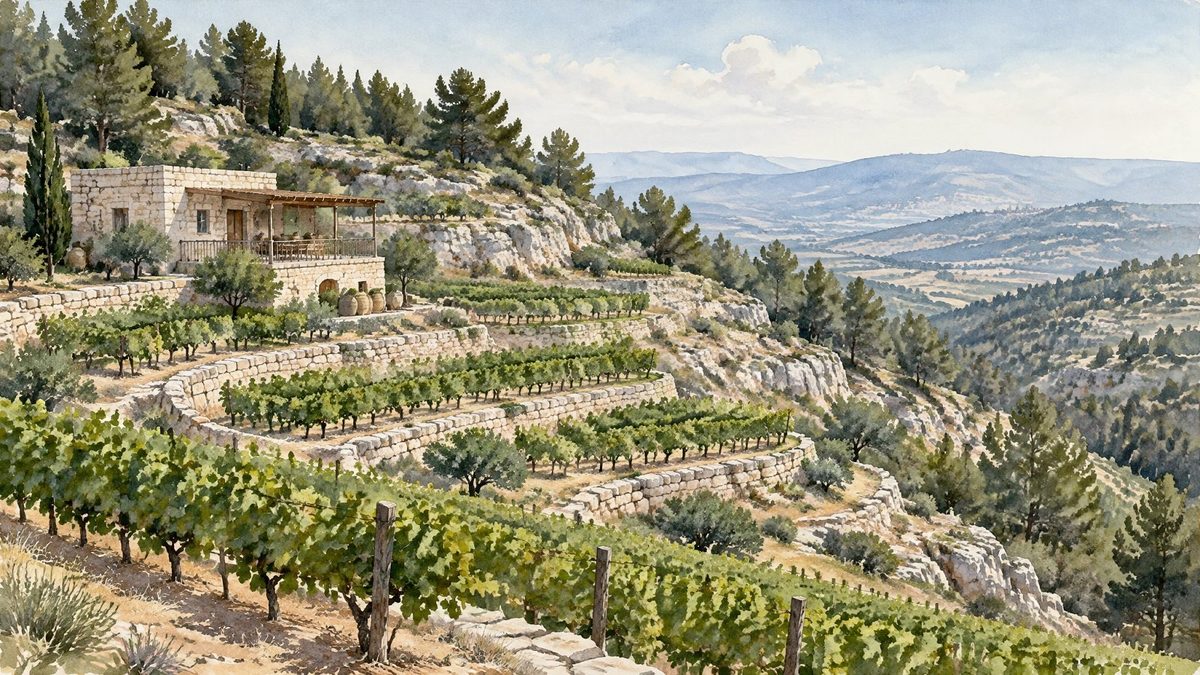
The Judean Hills climb from the coastal plain south-east of Tel Aviv to the mountains of Jerusalem, and their vineyards sit 400 to 800 metres above sea level, 40 to 50 kilometres from the Mediterranean. At harvest, while the coast swelters, night temperatures in the hills fall to 15°C, and winter rain reaches 400 to 650 mm between October and April. Those cool nights hold acidity in the grapes, the main reason the region is regarded as the leading white wine address in Israel. The soil is shallow terra rossa (a red, iron-rich clay) over limestone bedrock, between 0.2 and 0.7 metres deep. In August 2020 the Judea appellation (the legal designation guaranteeing that a wine was grown inside the regional boundaries) became the first official wine appellation in Israel. Its labels name two sub-regions: Judean Hills on the eastern ridge and Judean Foothills on the western slopes facing the sea. About 1,500 hectares of wine grapes grow there today, most of them on terraces or in dry riverbeds.
Modern winemaking here dates from the late 1980s, when the Jerusalem restaurateur Eli Ben Zaken and the Tzora grape grower Ronnie James each began making wine from their own vines. Between 30 and 40 boutique wineries now line the route that links the Judean Hills, the Valley of Elah and the Jerusalem Hills. In 2017 four of them, Domaine du Castel, Flam, Sphera and Tzora, formed the Judean Hills Quartet, a joint promotion group that has held events in New York, London and Tokyo. Castel, Flam and Tzora are the Judean Hills kosher wineries of that group, and the three anchor this route. The history runs much deeper: Genesis 49:11 to 12 has Jacob granting Judah this vine country.
"Old terraces carved into the rock and ancient limestone wine presses hint towards winemaking that goes back for thousands of years," wrote Cathrine Todd, wine writer for Forbes, in April 2019.
For the wider map, our magazine-style guide to discovering kosher Israel one neighborhood at a time places this wine day inside a full week of eating.
Flam Winery at Eshtaol, on the road up to the Jerusalem mountains
Flam Winery opened in 1998 in the Eshtaol Forest, midway between Tel Aviv and Jerusalem, and became kosher from the 2010 harvest. The founder's pedigree explains the house style: Israel Flam had already spent more than 30 years in the trade, many of them as chief winemaker of Carmel, before his sons Golan and Gilad opened the family estate with their mother, Camellia. At the time of the switch, Flam was the largest Israeli producer still making non-kosher wine, with well over 100,000 bottles a year. In 2017 Hugh Johnson's Pocket Wine Book (the annual British guide that rates producers from one to four stars) gave Flam four stars, a rating shared then by only two other Israeli wineries.
The visit takes place on a balcony surrounded by greenery and looking over the wild landscape of the Judean Hills. Two formats are on offer in 2026: the Classic tasting pours four wines for 155 NIS (new Israeli shekels) per person, and the Premium tasting pours three wines for 195 NIS. Both come with cheeses, spreads, olives and fresh bread from local producers. Bookings go through the Tabit reservation page linked from the winery site, and the grapes come from estate vineyards at Givat Yeshayahu and Even Sapir.
Among the Judean Hills kosher wineries, Flam is the stop for a reader who wants the family story told at the table. Ask for the hechsher (kashrut certification) printed on each bottle you taste, because certification on Israeli kosher wine is labelled bottle by bottle.
Domaine du Castel and the Grand Vin tasting history
Domaine du Castel is where the modern Judean Hills story begins, and the visit retraces it bottle by bottle. In 1988 Eli Ben Zaken, then owner of a Jerusalem Italian restaurant, planted Merlot and Cabernet Sauvignon behind his home at Ramat Raziel. His first harvest, in 1992, became Castel Grand Vin, Jérusalem, Haute-Judée, a Bordeaux tribute of about 600 bottles. In 1995 the actress Dalia Penn Lerner sent a bottle to Serena Sutcliffe MW (Master of Wine, the trade's top qualification), then head of the wine department at Sotheby's. Her enthusiastic reply turned a hobby into a professional winery.
The Grand Vin kept its rank. The 2016 vintage, a blend of Cabernet Sauvignon, Petit Verdot and Merlot aged in new French oak, placed No. 100 on the Wine Spectator Top 100 of 2019. Production had reached about 25,000 cases a year by then. Since 2015 the winery has worked from a new facility at Moshav Yad HaShmona, the stop closest to Jerusalem on this route, and by 2019 the founder's children Ilana, Ariel and Eitan ran export, operations and winemaking alongside him. Castel makes only kosher wine.
The guided tour walks from the winery to the barrel cellar and ends with a tasting of current releases with cheese, spreads and bread. It costs 155 NIS per person and lasts 1 to 1.5 hours. Entry is for guests aged 18 and over, and every visit requires a reservation.
Tzora Vineyards in the Judean foothills
Tzora Vineyards, on Kibbutz Tzora, is the estate for readers who care about vineyard origin. The late Ronnie James, a veteran grape grower on the kibbutz, founded it in 1993 and brought Eran Pick on board in 2006. Pick took over as winemaker in 2008 and later added the role of CEO. In February 2016 he became the first Israeli Master of Wine, at a time when only 343 people worldwide held the title. The range follows the vineyard map across three labels: Judean Hills, Shoresh and the flagship Misty Hills.
The tasting room keeps the most precise published schedule of the three: Sunday to Thursday from 10:00 to 16:00, Friday from 09:00 to 14:00. The standard visit is a seated, guided tasting of four current releases with artisanal cheeses, bread and olive oil, at 125 NIS per person, for up to 60 minutes. A private tasting room takes small groups, booked by phone. One international booking platform lists the same tasting from 31 euros, rated 4.8 out of 5 across 13 reviews. Book the standard tasting online through Ontopo.
Tzora opens earliest on Friday, which makes it the natural first stop on a short Friday route. If you are basing yourself in town, our pick of Jerusalem kosher hotels chosen by what the dining room actually does gives you the right base for an early start west.
White wine at the Judean Hills kosher wineries
The Quartet's white-wine specialist, Sphera Winery at Givat Yeshayahu, shows no kosher certificate on its own pages, so TaamTaam leaves it off this route. The region's limestone bedrock gives its whites their mineral character. Ask Castel, Flam and Tzora on booking which whites are pouring that day, and request a white-only flight if that is your preference.
How to plan a winery day in Israel from Jerusalem
A one-day route through the Judean Hills kosher wineries covers two tastings and one lunch table. Three wineries is the ceiling, because each seated visit runs 60 to 90 minutes before the drive. The sequence below starts with the stop farthest west and works back toward Jerusalem, so the last leg home is the shortest.
- Pick a Sunday to Thursday. Castel and Tzora publish no Saturday hours, Saturday night after havdalah included. On a Friday, Castel closes at 14:00 in autumn and winter, Tzora at 14:00 all year. On the eve of a chag (a Jewish festival day), confirm hours by phone.
- Open at Tzora at 10:00. It is the westernmost stop, on Kibbutz Tzora, and its 60-minute tasting ends at 11:00.
- Second tasting at Flam. Eshtaol lies a few kilometres from Tzora, so a Classic tasting fits between 11:15 and 12:10.
- Lunch table at Castel. Yad HaShmona sits nearest Jerusalem; take the 12:30 table in autumn and winter, or the 11:00, 12:00 or 14:00 slot from spring.
- Name the driver. The driver tastes and spits, or skips the pour.
- Lock all three bookings together. Castel requires a reservation for every visit, Tzora books through Ontopo and Flam through Tabit. Our recommendation: book seven days ahead for a weekday and 14 days ahead for a Friday or a week with a chag.
| Stop | Location | Published visit format | Price per person (2026) | Booking channel |
|---|---|---|---|---|
| Tzora Vineyards | Kibbutz Tzora | Seated tasting, 4 wines, up to 60 min | 125 NIS | Ontopo |
| Flam Winery | Eshtaol Forest | Classic tasting, 4 wines | 155 NIS | Tabit |
| Domaine du Castel | Yad HaShmona | Tour and tasting, 1 to 1.5 h | 155 NIS | Ontopo or phone |
Booking the long-table lunch at Domaine du Castel
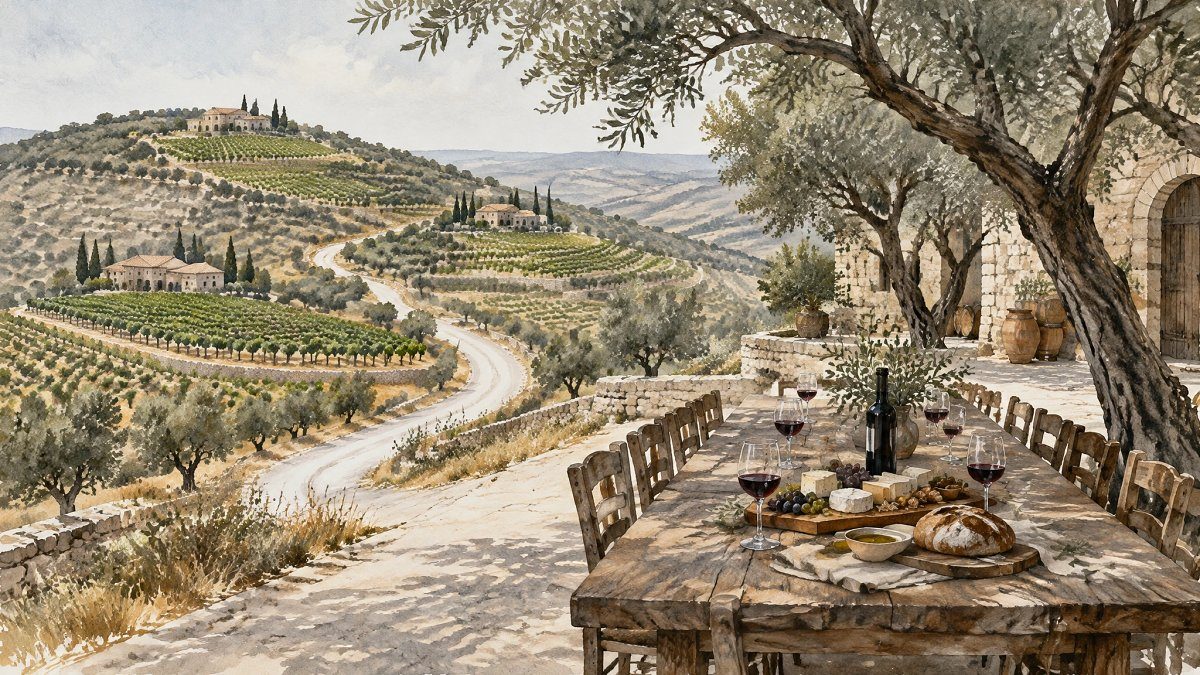
Castel is the lunch stop because it is the only one of the three Judean Hills kosher wineries on this route that publishes a table reservation on top of its tours. The table runs Sunday to Thursday at 12:30 in autumn and winter, and at 11:00, 12:00 or 14:00 in spring and summer. Guests order wine by the glass at 18 to 45 NIS per 100 ml pour, depending on the wine, with a cheese platter for two at 89 NIS. On Fridays the minimum order is 90 NIS per guest and the platter costs 115 NIS. For a longer sit-down, Castel sells a picnic case for two at 340 NIS, or 209 to 369 NIS with a bottle swapped in for the tasting pours.
The menu is dairy, and the wine certification does not cover the kitchen. Before you book the table, ask the visitor centre for its own food certificate and whether the cheese is halav Israel (milk supervised by an observant Jew from milking onward). For a group long table, Flam caters business groups by prior arrangement, from artisan cheeses to chef meals made with local produce.
Here is the worked cost for two people on the autumn route. Tzora: 2 x 125 NIS = 250 NIS. Flam Classic: 2 x 155 NIS = 310 NIS. Castel table, two 100 ml pours each at 30 NIS plus one platter: 120 NIS + 89 NIS = 209 NIS. The day totals 769 NIS before fuel.
FAQ: Judean Hills kosher wine route
Are all Judean Hills kosher wineries closed on Shabbat?
Castel and Tzora, the two kosher estates on this route that publish full schedules, list no Saturday opening. Their weekday hours run from 10:00 to 16:00, and their Friday windows close at 14:00 or 15:00 depending on the season. Flam publishes no hours on its visit page; its online booking calendar shows the open slots. Plan the day for Sunday to Thursday, and confirm hours by phone before a chag.
How many wineries can you visit in one day in the Judean Hills?
Two tastings and one lunch table is the comfortable pace at the Judean Hills kosher wineries, and three wineries is the limit. Each seated visit lasts 60 to 90 minutes: Tzora up to 60 minutes, Castel 1 to 1.5 hours. Tzora and Flam stand a few kilometres apart, so those two pair easily. Castel at Yad HaShmona is the stop nearest Jerusalem, which makes it the natural last visit and the lunch table before the drive home.
Is the food at a winery tasting kosher too?
The wine hechsher and the food certificate are two separate documents. The three wineries make kosher wine and all serve dairy platters with their tastings: cheeses, bread, spreads or olive oil. Ask each visitor centre for its own food certificate, its supervising body and whether the cheese is halav Israel. A Rabbanut certificate and a Badatz certificate (issued by a Haredi rabbinical court) are different certification levels.
How far ahead should you book a winery tasting?
Castel requires a reservation for every visit, and Tzora and Flam book their tastings online through Ontopo and Tabit. Our recommendation is seven days ahead for a weekday visit and 14 days ahead for a Friday or a festival week, because the Friday window closes at 14:00.
Which winery on the route has the most famous wine?
Domaine du Castel holds the longest record. Its first Grand Vin, made in 1992 at about 600 bottles, launched the modern Judean Hills, and the 2016 vintage ranked No. 100 on the Wine Spectator Top 100 of 2019. Tzora answers with Eran Pick, who became the first Israeli Master of Wine in 2016, and Flam with a four-star rating from Hugh Johnson's Pocket Wine Book in 2017.
How TaamTaam books your Judean Hills wine day
TaamTaam builds a day at the Judean Hills kosher wineries around the kashrut questions a wine route raises and the dinner that follows it. Send your date through the TaamTaam concierge booking form and the team books the dinner that closes the day.
Kashrut verification. TaamTaam lists more than 143 verified kosher restaurants across 8 Israeli cities, and each listing reports the supervising body, certification level, halav Israel status, vegetable compliance and separate meat hechsher where it applies.
Direct booking and mashgiach calls. The free concierge books tables directly and calls the mashgiach (the kashrut supervisor on site) directly, so the kashrut questions about your dinner table are answered before you sit down.
The dinner after the vineyards. Active coverage in Jerusalem, Tel Aviv, Caesarea and Herzliya means the evening table is booked with the same rigour as the lunch, with supervisors verified across the Rabbanut, Badatz Eda Chareidis, Badatz Beit Yosef and the OU.
Conclusion
A route through the Judean Hills kosher wineries is short, and its success depends on the bookings: Tzora at 10:00, Flam before noon, Castel's lunch table at 12:30, all locked a week ahead and checked for kashrut beyond the wine label. Planning your first trip to Israel as an observant traveler, planned the right way leaves room for one such day, and for a second wine region later in the week, a Galilee and Golan winery tour day completes the picture. Book the three Judean Hills kosher wineries in one sequence and the day takes care of itself.
Also worth reading:
- Picking kosher hotels, wineries and tasting routes worth the booking
- Your first trip to Israel as an observant traveler, planned the right way
- A magazine-style guide to discovering kosher Israel one neighborhood at a time
- How TaamTaam thinks about kosher occasion dining in Israel
- Jerusalem kosher hotels picked by what the dining room actually does
Sources:
- Judean Hills and Iter Vitis together to create the Wines of the Bible Wine Route: Iter Vitis, 17 June 2024
- Judean Hills Wine Route: Isrotel Hotels, read 15 October 2026
- Plan Your Wine Travel in Judean Hills: WineTourism.com, read 15 October 2026
- Sip the wines of the fabulous Judean Hills terroir: ISRAEL21c, 18 March 2020
- The Judean Hills Quartet: Judean Hills Quartet, read 15 October 2026
- Visitor Center: Domaine du Castel, read 15 October 2026
- Domaine du Castel: A Miraculous Wine Story: The Jewish Standard, 10 December 2019
- Visit: Tzora Vineyards, read 15 October 2026
- Eran Pick MW: Israeli Wines, 29 February 2016
- Visit us: Flam Winery, read 15 October 2026
- Flam & Saslove go Kosher: Israeli Wines, 1 January 2012
- Sphera Winery: Israel.com, 5 October 2026