
Jerusalem rewards the diner who walks. The city's kosher tables cluster by neighborhood, each with its own certification culture, its own closing hour, and its own reason to linger after dark. This jerusalem kosher neighborhood guide maps eleven of those areas, from the Mamilla Mall against the Old City walls to the quiet dairy rooms of Baka, and points you to the dedicated route for each one. It is built for the observant traveler who already reads a hechsher (the kashrut certification mark) at a glance and wants the evening planned, not explained. Israel welcomed 1.3 million international visitors in 2025, roughly 31% of them from the United States, about 12% from France and 7% from the United Kingdom, according to The Jerusalem Post, and most pass through Jerusalem. The tables below tell you where they should eat, and when.
Key takeaways:
- Jerusalem's kosher dining splits by neighborhood: Mamilla for views, Machane Yehuda for late nightlife, Emek Refaim and Baka for relaxed dairy rooms, Mishkenot Shaananim for a single gourmet meat table at Touro.
- The German Colony alone holds roughly three dozen kosher restaurants, per iTravelJerusalem, and most of the Emek Refaim street is certified.
- Jewish Quarter kitchens inside the Old City close early, usually by 17:00 to 18:00, so plan the Quarter for daytime and dinner elsewhere.
- Certification varies table to table: Rabbanut (the state Chief Rabbinate), Badatz (an independent ultra-Orthodox court), and mehadrin (a stricter standard) are not interchangeable, and a mashgiach (the on-site supervisor) is your point of confirmation.
- TaamTaam verifies kashrut on 143+ restaurants across 8 Israeli cities and books your table, and your mashgiach call, for free.
What this Jerusalem kosher neighborhood guide covers
This guide is for the observant traveler who lands in Jerusalem with a hechsher standard already in mind and a week of evenings to fill. It treats each restaurant as a stop on a route, not a standalone review, and it hands you off to a dedicated article for every neighborhood. What it does not do is settle halachic disputes between supervisors or rank one Badatz against another. It tells you who certifies a table so you can decide for yourself.
The audience is specific. Visitors stayed an average of 9.3 nights and spent $1,622 per trip in 2025, up from $1,427 in 2024, while 88% rated the visit satisfying and 83% said they would recommend Israel, according to The Jerusalem Post. Those are travelers with a week of dinners to plan, and this jerusalem kosher neighborhood guide is built to plan them table by table rather than meal by meal.
Jerusalem's kosher map is dense. The German Colony alone holds roughly three dozen kosher restaurants, and the Machane Yehuda shuk (the central covered market) turns over more than 250 vendors by day and more than ten bars by night. The neighborhoods below are ordered the way an evening actually unfolds: views first at Mamilla, late energy at the shuk, calm dairy rooms in Baka and the German Colony, and a single gourmet meat dinner at Touro when the occasion calls for it.
| Neighborhood | The evening it suits | Named kosher tables | When to go |
|---|---|---|---|
| Mamilla Mall | Old City views over dinner | Cafe Rimon, The Rooftop | Sunset onward |
| Machane Yehuda | Late, loud, bar-driven | Machneyuda, Crave, Ishtabach | Thursday night |
| Emek Refaim | Relaxed dairy and dessert | Caffit, Pompidou, Burgers Bar | Motzash, after Shabbat |
| Jewish Quarter | Daytime touring near the Kotel | Seoul House, Holy Cafe | Before 18:00 |
| First Station | Families, variety in one plaza | Lechem Basar, Station 9, Fresh Kitchen | Evening |
| Baka | A quiet dairy nightcap | Ben Ami, Grand Cafe | After dinner |
| Mishkenot Shaananim | One gourmet meat dinner | Touro | Evening, by reservation |
| Rehavia | Where locals eat midweek | Sushi Rehavia, Sheyan, Azia | Thursday night |
| Ben Yehuda, Jaffa Road | Visitors between meetings | Angelica, Cafe Rimon, Kadosh | Daytime to evening |
Read the table, pick the evening that fits your party, then open the route. A note on timing: the Jewish Quarter inside the walls eats early and closes by evening, while the shuk only wakes up after dark. Cross-town distances are short, but Jerusalem's hills are real, so this jerusalem kosher neighborhood guide groups tables you can reach on foot within each area.
Mamilla Mall: kosher tables with the Old City as backdrop
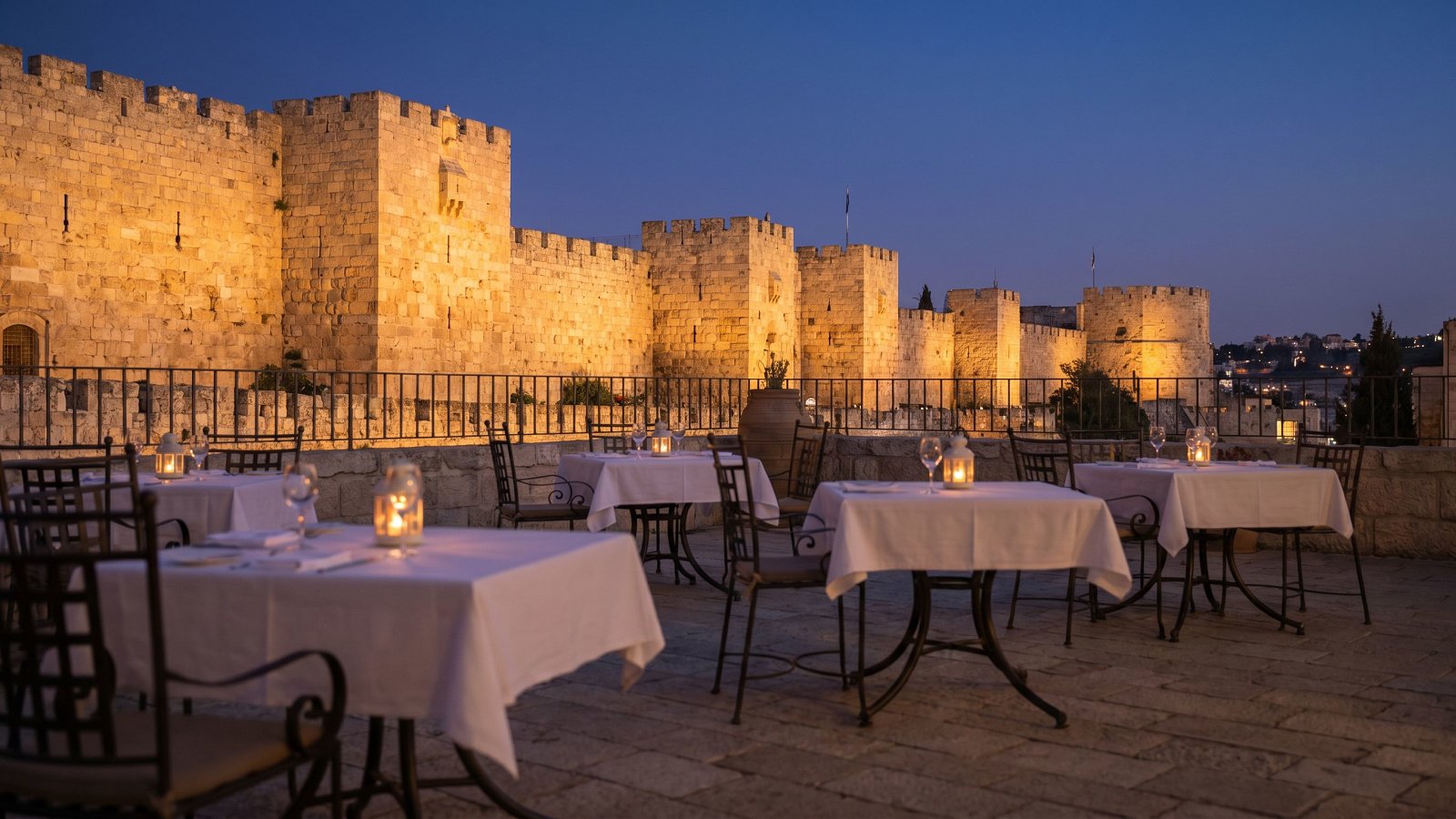
The Mamilla Mall is the softest landing in Jerusalem for a first kosher dinner, and the gentlest opening in this jerusalem kosher neighborhood guide. The open-air promenade runs from the Jaffa Gate toward the city center, lined with restaurants that are, with few exceptions, kosher. Cafe Rimon, the flagship of a family business the Rimon family has run since 1953, anchors the dairy-and-fish end, while The Rooftop, atop the Mamilla Hotel, sets meat courses against a direct view of the ramparts, a pairing KosherSquared singles out in its Jerusalem ranking.
This is the evening for travelers who want the city's most famous skyline over dinner without a long walk. Sunset is the moment: the limestone turns gold, and the promenade fills with a mix of hotel guests and Jerusalemites. Most Mamilla kitchens carry Rabbanut Yerushalayim certification, and several upper-end rooms hold mehadrin, so confirm the standard for your table rather than assuming the mall is uniform.
Fish runs strong here. Sea bass and salmon dominate the dairy menus, and the kosher fish scene in Jerusalem is at its most polished on this stretch. Families with strollers manage the flat promenade easily, and the proximity to the Jaffa Gate means dinner can flow straight into an evening walk along the ramparts.
For the full sequence, where to start, which room takes the sunset, and how to time the walk into the Old City, follow our complete Mamilla Mall evening route. It is the cleanest introduction to eating in Jerusalem for anyone arriving with luggage and a reservation but no map.
Machane Yehuda after dark: the kosher rooms past the stalls
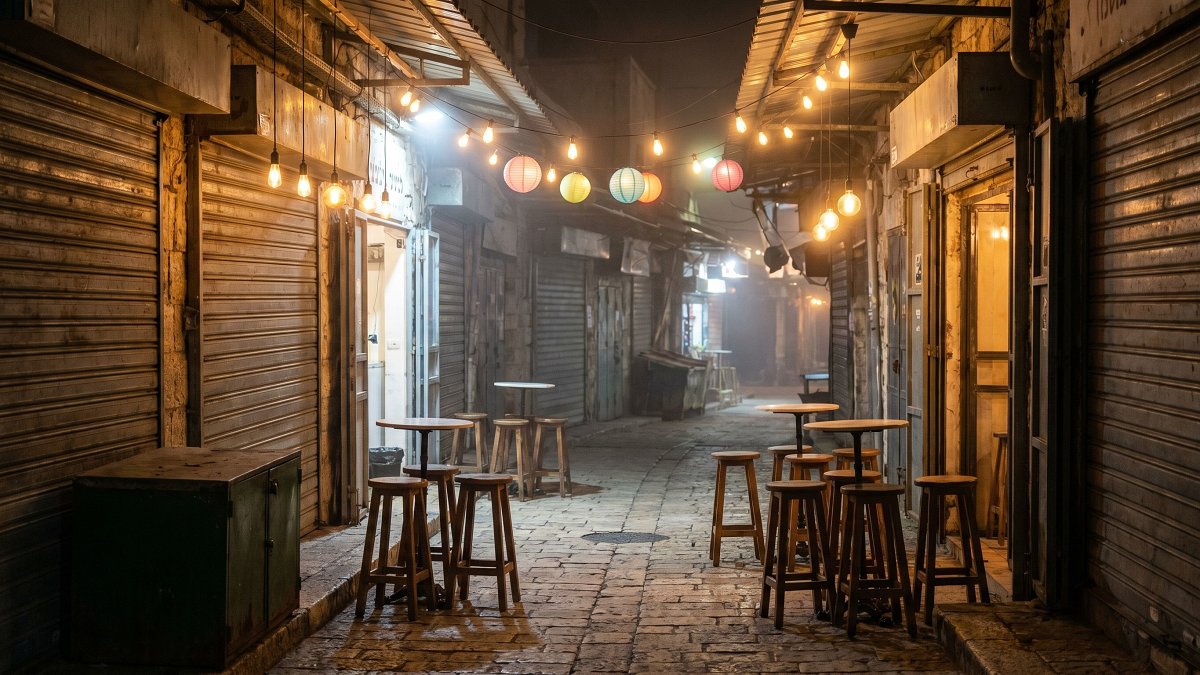
No jerusalem kosher neighborhood guide can skip the shuk. By day, Machane Yehuda is a working market of more than 250 vendors. After dark, it becomes the center of Jerusalem nightlife, a shift that took hold over the last five years, with more than ten bars and a wave of restaurants filling the lanes once the produce stalls roll down their shutters. Jamie Geller's ultimate guide to the shuk traces the transformation, and it is the single best argument for eating in Jerusalem on a Thursday night.
Machneyuda, the restaurant that took the market's name, opened in 2009 under three Jerusalem chefs and still sets the tone: loud, ingredient-driven, built on what the stalls sold that morning. Crave brings Western comfort food, fish tacos to beef sliders, to a kosher kitchen built to mimic the non-kosher classics. Ishtabach, just off the market, builds its reputation on Kurdish meat pastries with flaky dough.
This is the neighborhood for diners who want energy, not quiet, and who do not mind standing for a table. The crowd skews under 40 on Thursday nights, when the whole city seems to descend on the lanes. Kashrut varies stall to stall and room to room, so a mashgiach check matters more here than anywhere: confirm each establishment's hechsher individually, since the market mixes certified rooms with bars that are not.
For the route past the stalls, which rooms to book and which to walk into, follow the Machane Yehuda after-dark walk. Go hungry, go late, and go on a Thursday.
Emek Refaim and the German Colony on a Saturday night
When Shabbat ends, the German Colony comes back to life faster than almost anywhere in Jerusalem, which is why this jerusalem kosher neighborhood guide treats Emek Refaim as the natural motzash table. Emek Refaim, the neighborhood's spine, holds roughly three dozen kosher restaurants along a single walkable street, and most of the street is certified, according to iTravelJerusalem's German Colony restaurant guide. Motzash, the hour after Shabbat ends, is when local families pour out for a late dinner or dessert.
Caffit set the template. It opened in 1987 as a neighborhood cafe and still serves a Jerusalem-style dairy menu that defines the area's relaxed register. Pompidou runs a dairy bistro kitchen; Burgers Bar, the chain that started on this very street, handles the meat side and the family burger run. Aldo turns out both dairy ice cream and sorbet for the after-dinner stroll.
This is the evening for travelers who want neither the shuk's noise nor a formal meat dinner, just a calm table among locals. The German Colony reads anglo-friendly: English is common, menus are bilingual, and the pace is unhurried. Certification skews Rabbanut with several mehadrin rooms, and the dairy weighting means Halav Yisrael (milk supervised from the moment of milking) status is the detail to confirm if you hold by it.
Abu Tor, the quiet ridge just uphill, sends its diners down to this same stretch, which is why the German Colony works as a hub for the whole southern arc of the city. For the timed walk, where to land right after Shabbat and where to end with dessert, follow the Emek Refaim and German Colony evening.
An evening in the Jewish Quarter when the Old City quiets down
The Old City eats early, and this jerusalem kosher neighborhood guide builds the Jewish Quarter into the front of the day for that reason. Inside the walls, kosher restaurants exist almost entirely in the Jewish Quarter, and most close by 17:00 to 18:00 as the day visitors leave, per YeahThatsKosher's Jewish Quarter feature. That timing is the whole strategy: treat the Quarter as a late-afternoon meal near the Kotel, then move out for dinner.
Seoul House, the world's first kosher Korean restaurant, sits at 34 Chabad Street under Rabbanut Yerushalayim supervision, and it is the Quarter's most distinctive table. Holy Cafe, on Hurva Square, serves a dairy menu in the heart of the Quarter, well placed for a meal between touring and the walk to the Western Wall. For groups, several Quarter venues run private dining overlooking the Kotel.
This is the evening, really the late afternoon, for travelers anchoring their day around the Kotel rather than around dinner. The reward is location: nowhere else can you eat a certified meal minutes from the Western Wall. The constraint is the clock, so build the Quarter into the start of the day and let a neighborhood like the German Colony or First Station carry the actual dinner.
When the lanes quiet after the tour groups thin out, the Quarter takes on the stillness that makes it worth lingering. For the full sequence, what to eat before closing and where to walk as the gates empty, follow an evening in the Jewish Quarter when the Old City quiets down.
First Station after sundown: three kosher rooms and a walk to the Old City
The First Station, Jerusalem's restored Ottoman railway terminal (HaTachana HaRishona), packs more kosher variety into one plaza than any single street in the city, which is why this jerusalem kosher neighborhood guide hands it to families first. For a party that cannot agree on cuisine, it solves the argument. Lechem Basar, a kosher mehadrin steakhouse, runs the serious meat program and stays open through Pesach chol hamoed with no kitniyot, a detail that matters to Passover travelers. Station 9 plays Asian fusion across Thai, Vietnamese, Japanese and Israeli registers, and Fresh Kitchen handles the kosher dairy mehadrin side.
The plaza format is the point: open space, live music on many evenings, room for strollers and grandparents in the same party. Captain turns out kosher burgers for the casual end, so the meat eaters and the burger-only kids are covered at neighboring tables. The kosher burger run in Jerusalem rarely gets easier than this, and the shared courtyard means one table's wait is another table's dessert.
This is the evening for multi-generational groups and for visitors who want one decision to cover everyone. From the Station, the walk toward the Old City, past the Cinematheque and up toward the walls, turns dinner into an itinerary rather than a stop.
For the full walk, which of the three rooms suits your party and how to time the stroll afterward, follow the First Station after-sundown route.
Baka after dinner: the quiet kosher dairy room around the corner
Baka is where Jerusalem goes to slow down, and this jerusalem kosher neighborhood guide treats it as the nightcap rather than the main event. Residential, leafy, and just south of the German Colony, it is not a dining destination so much as a neighborhood with the right dairy room around the corner. Ben Ami runs a dairy kitchen with a fully separate gluten-free menu, and Grand Cafe sits on Derech Beit Lechem for coffee and dessert after a meal elsewhere. Super Hamizrach by Jacko's Son brings sushi and Asian meat dishes to the same stretch for those who want dinner, not just dessert.
This is the evening for travelers staying in the southern neighborhoods who want a short, calm walk rather than a night out, and for anyone winding down after a louder dinner at the shuk or the First Station. Certification along Derech Beit Lechem skews Rabbanut, with the dairy rooms the natural fit for a late, light table, and the residential setting keeps the noise low even on a weekend.
The pleasure of Baka is its quiet: no crowds, no queue, a neighborhood pace that reads as resident Jerusalem rather than tourist Jerusalem. For the short route, which corner room to end the night in and how it pairs with a German Colony dinner, follow the quiet Baka dairy evening.
Mishkenot Shaananim and the windmill: Touro at the end of the walk
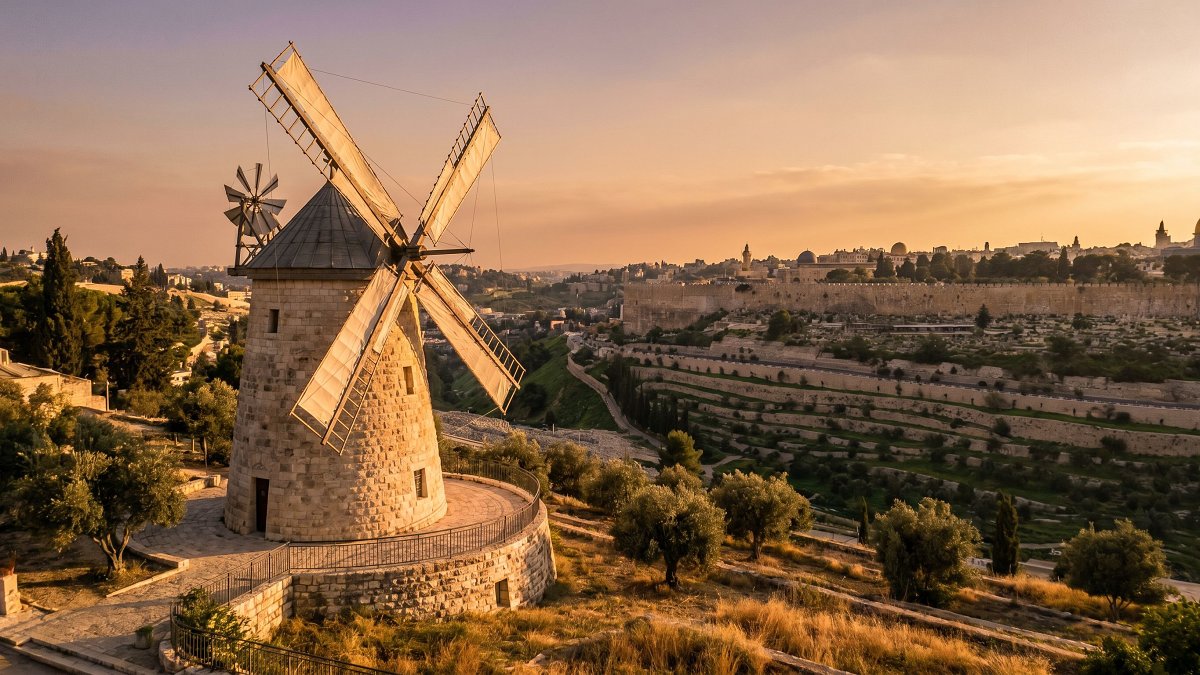
Some evenings call for one gourmet meat dinner and nothing else, and this jerusalem kosher neighborhood guide sends them to Mishkenot Shaananim. The first Jewish neighborhood built outside the Old City walls in the 1860s is made for exactly that. Touro, a kosher chef's restaurant at the foot of the Montefiore windmill, is the destination: a Mediterranean meat menu with Asian influences under chef Benny Ashkenazi, in a preserved historic building that once hosted Mayor Teddy Kollek's guests, according to iTravelJerusalem's Touro profile. The restaurant is named for Judah Touro (1775 to 1854), the American-Jewish philanthropist whose bequest funded the neighborhood.
This is the evening for an anniversary, a deal closed, or a single special meal with the ramparts glowing across the valley. Touro seats events of up to 120 guests on its balcony and holds a private room for 20, so it doubles as the address for a celebration. The walk in matters as much as the meal: down from Yemin Moshe, past the windmill, with the walls in view the whole way.
The kashrut here is meat, certified, and the room expects reservations, so this is not a walk-in neighborhood. For the full approach, the windmill walk, the reservation timing and the view to ask for, follow the Mishkenot Shaananim windmill walk to Touro.
Rehavia, where Jerusalem locals actually eat: a Thursday-night route
Rehavia is the neighborhood Jerusalemites name when they are not performing for tourists, and the one place in this jerusalem kosher neighborhood guide that reads as a local secret. Quiet, central, and academic in character, it eats well without fuss. Sushi Rehavia has anchored the city's sushi scene for over ten years, with branches on Rabbi Akiva and Gaza Road. Sheyan runs a mehadrin Asian room, Azia handles Japanese under the same ownership as First Station's Station 9, and Bagel Cafe keeps a mehadrin dairy counter for the casual midday table.
This is the evening for travelers who want the local register, where anglos and Israelis overlap and the menu is not translated for visitors. Thursday night, the unofficial start of the Israeli weekend, is when Rehavia's tables fill with the city's professionals and students. Certification runs from Rabbanut to mehadrin depending on the room, and the Asian weighting means fish and sushi, not meat, define the area's signature plates.
Rehavia rewards the diner who treats it as a Thursday-night route rather than a single stop: a sushi table, a dessert counter, a short walk between them. For the full sequence and the rooms locals actually book, follow Rehavia where Jerusalem locals actually eat.
Ben Yehuda, Jaffa Road and the downtown pedestrian stops
Downtown Jerusalem is the visitor's default, and the part of this jerusalem kosher neighborhood guide built for walking. Ben Yehuda Street is a midrachov (a pedestrian street closed to traffic), running from King George to Jaffa Road, and it is dense with kosher options for travelers between meetings or between sights. Cafe Rimon, the kosher Italian institution the Rimon family has run since 1953, anchors the street, while Pisgat HaFalafel keeps a strictly kosher and vegan counter for a fast, certified bite.
Jaffa Road, the artery the light rail now runs along, carries the city-center heavyweights. Angelica, the city-center kosher restaurant known for its steaks, chicken liver pate and roast beef bruschetta, is the address for a serious downtown dinner, and Time Out Israel's Jerusalem coverage maps the wider city-center field around it. Kadosh, the cafe-patisserie founded in 1967, brings a Parisian register and what locals defend as the city's best croissant.
This is the evening for business travelers and first-timers who want certified food within a short walk of a hotel. The downtown rooms run the full kashrut range, so confirm each table's hechsher individually. For the pedestrian sequence, follow the Ben Yehuda Street pedestrian kosher stops for visitors. The companion downtown walk, built around meetings rather than sightseeing, is the Jaffa Road route linked below.
How this Jerusalem kosher neighborhood guide reads kashrut at every table
Jerusalem certifies its kitchens through several authorities, and they are not interchangeable. Every route in this jerusalem kosher neighborhood guide assumes you want to know which one stands behind your table, so before you sit down, six things tell you exactly what you are eating.
- The hechsher level. Look for the certificate on the wall. Rabbanut, the state Chief Rabbinate, is the baseline; Badatz courts such as Eda Chareidis and Beit Yosef apply stricter standards; mehadrin denotes the elevated tier. A room may hold one and not another.
- Halav Yisrael status. Dairy rooms vary on whether the milk was supervised from milking. The German Colony's dairy bistros and Baka's cafes are where this question comes up most.
- Vegetable compliance. Leafy greens and herbs require insect-checking. Mehadrin kitchens document their process, so ask if the menu leans on salads and herbs.
- Separate meat certification. Meat rooms like Lechem Basar and Touro carry their own meat hechsher; confirm it rather than assuming an umbrella mark covers the kitchen.
- Mashgiach access. The mashgiach is the on-site supervisor. The strongest confirmation is a direct word with that person, which is exactly what a concierge can arrange before you arrive.
- Shabbat and chag policy. Certified kitchens close for Shabbat and festivals, then reopen at varying hours on motzash, so plan Saturday-night dinners around the actual reopening rather than sundown.
These six checks are the difference between kosher-friendly marketing and verified kashrut. TaamTaam runs every one of them on each listing and reports the supervising body, certification level and Halav Yisrael status table by table.
Three Jerusalem evenings TaamTaam booked, start to finish
The routes in this jerusalem kosher neighborhood guide come from evenings TaamTaam actually planned. Three recent cases show how the neighborhoods play out in practice.
A family of seven, Badatz only, wanted one dinner near the Old City during a December visit. The concierge booked The Rooftop at the Mamilla Hotel for the view, confirmed the meat hechsher and a Halav Yisrael dessert substitution by phone with the mashgiach, and timed the table for 45 minutes after sunset. The result was a 90-minute dinner, walls lit, with no kashrut question left open at the table.
A couple marking an anniversary asked for the single best kosher meat room with a view. The match was Touro at the windmill in Mishkenot Shaananim, the private corner for two rather than the 120-seat balcony, booked three weeks ahead because the room fills. The walk down from Yemin Moshe was built into the evening as the approach.
A group of twelve students wanted the Thursday-night shuk without the guesswork. The concierge mapped a Machane Yehuda crawl: Machneyuda for the opening plates, Ishtabach for Kurdish pastries, and a vetted bar with a standing hechsher to close, each room confirmed individually so the certified stops never blurred into the uncertified ones. The party walked in at 22:00 and stayed past midnight.
Each evening turned on the same thing: verified kashrut, confirmed by a mashgiach, and booked before arrival.
FAQ: planning kosher evenings across Jerusalem
How is this Jerusalem kosher neighborhood guide different from a restaurant list?
A list ranks restaurants; this jerusalem kosher neighborhood guide routes you by area and by the kind of evening you want. Each section points to a dedicated walk with addresses, certification notes, and timing, so you choose where the night happens before you choose a dish. It also reports who certifies each table, Rabbanut, Badatz or mehadrin, rather than labeling everything kosher-friendly.
Which Jerusalem neighborhood is best for a kosher dinner with an Old City view?
The Mamilla Mall and Mishkenot Shaananim. The Rooftop at the Mamilla Hotel sets meat courses against the walls, while Touro, at the foot of the Montefiore windmill in Mishkenot Shaananim, pairs a gourmet kosher meat menu with the ramparts across the valley. Both expect reservations, especially around sunset.
Where can I find late-night kosher dining in Jerusalem?
Machane Yehuda. Over the last five years the shuk became the center of Jerusalem nightlife, with more than ten bars and restaurants like Machneyuda and Crave running late, especially on Thursday nights when the crowd skews under 40. Confirm each room's hechsher individually, since certified rooms sit beside uncertified bars.
Are the Old City and Jewish Quarter restaurants open for dinner?
Mostly not. Kosher kitchens in the Jewish Quarter, such as Seoul House and Holy Cafe, generally close by 17:00 to 18:00 as day visitors leave. Treat the Quarter as a late-afternoon meal near the Western Wall, then move to the German Colony or the First Station for the actual dinner.
What kosher certifications should I look for in Jerusalem?
Three matter most. Rabbanut Yerushalayim is the state baseline; Badatz courts such as Eda Chareidis and Beit Yosef apply stricter standards; mehadrin marks the elevated tier. For dairy rooms, check Halav Yisrael status, and for meat rooms confirm the separate meat hechsher. A mashgiach can confirm any of these on site.
Can TaamTaam confirm a restaurant's kashrut before I book?
Yes. TaamTaam reports the supervising body, certification level, Halav Yisrael status and separate meat hechsher for 143+ restaurants across 8 Israeli cities, and the free concierge calls the mashgiach directly before your reservation. You arrive with the certification confirmed rather than assumed.
How TaamTaam books your Jerusalem evening
Reading the map is the start. Booking the evening, and confirming the kashrut, is where TaamTaam turns this jerusalem kosher neighborhood guide into a reservation, for free.
Verified kashrut, table by table. TaamTaam lists 143+ kosher restaurants across 8 Israeli cities, with active Jerusalem coverage, and reports the supervising body, certification level, Halav Yisrael status and separate meat hechsher for each one. No kosher-friendly labeling, no guesswork.
Direct mashgiach access. Where a question needs the supervisor, the concierge calls the mashgiach directly before your reservation, so you arrive with the certification confirmed rather than hoped for. This is the layer a plain restaurant list cannot give you.
One table, one call. The free concierge books the room, sequences the route, and handles the timing around Shabbat and motzash. A single conversation covers the whole evening, from the Mamilla sunset table to the Machane Yehuda close.
To plan your Jerusalem evenings with verified kashrut and a booked table, talk to the TaamTaam concierge. Tell us the neighborhood, the party, and the standard you hold by, and we build the night around it.
Conclusion
Jerusalem is not one kosher dining scene but eleven, each neighborhood keeping its own hours, its own certification culture, and its own kind of evening. The Mamilla promenade sells the view, the Machane Yehuda shuk sells the night, the German Colony and Baka sell the calm, and Touro at the windmill sells the single perfect meat dinner. The traveler who plans by neighborhood eats better than the one who chases a single famous name across town.
Use the table to choose the evening, open the route for the walk, and let the certification notes do the worrying for you. This jerusalem kosher neighborhood guide exists so that an observant visitor can land, read a hechsher at a glance, and spend the evening eating rather than verifying. When you are ready to book, the TaamTaam concierge turns the right neighborhood from this jerusalem kosher neighborhood guide into a confirmed table and a direct word with the mashgiach.
Sources
Read also across TaamTaam
- Downtown Jaffa Road kosher stops for the visitor between meetings
- Yemin Moshe after sundown, the walk that leads to dinner
- Talbieh and the quiet kosher tables near the President's house
- Katamon kosher rooms where anglos and Israelis overlap
- Ramat Eshkol and French Hill, north Jerusalem kosher evenings
- Tel Aviv Port at sundown, three kosher rooms on the boardwalk
- A serious editor's guide to kosher date nights in Israel
- Planning an observant trip to Israel with the rigor of a concierge
- How TaamTaam thinks about kosher occasion dining in Israel
External sources
- Tourism rebounds with 1.3 million visitors in 2025 : The Jerusalem Post, 2025
- Ultimate Guide to Machane Yehuda Market : Jamie Geller, 2024
- Restaurants in the German Colony and Emek Refaim : iTravelJerusalem, 2024
- Restaurants at the First Station : iTravelJerusalem, 2024
- Touro Restaurant : iTravelJerusalem, 2024
- The Top 20 Must-Try Best Kosher Restaurants in Jerusalem : KosherSquared, 2024
- Finding Kosher Restaurants in Jerusalem's Old City Jewish Quarter : YeahThatsKosher, 2025
- The best Jerusalem restaurants from Machneyuda to Mamilla : Time Out Israel, 2024
- Visiting Jerusalem's Ben Yehuda Street : Mark Around The World, 2024